3-Year Diploma Scholarship in China 2027 | Matric FSc DAE
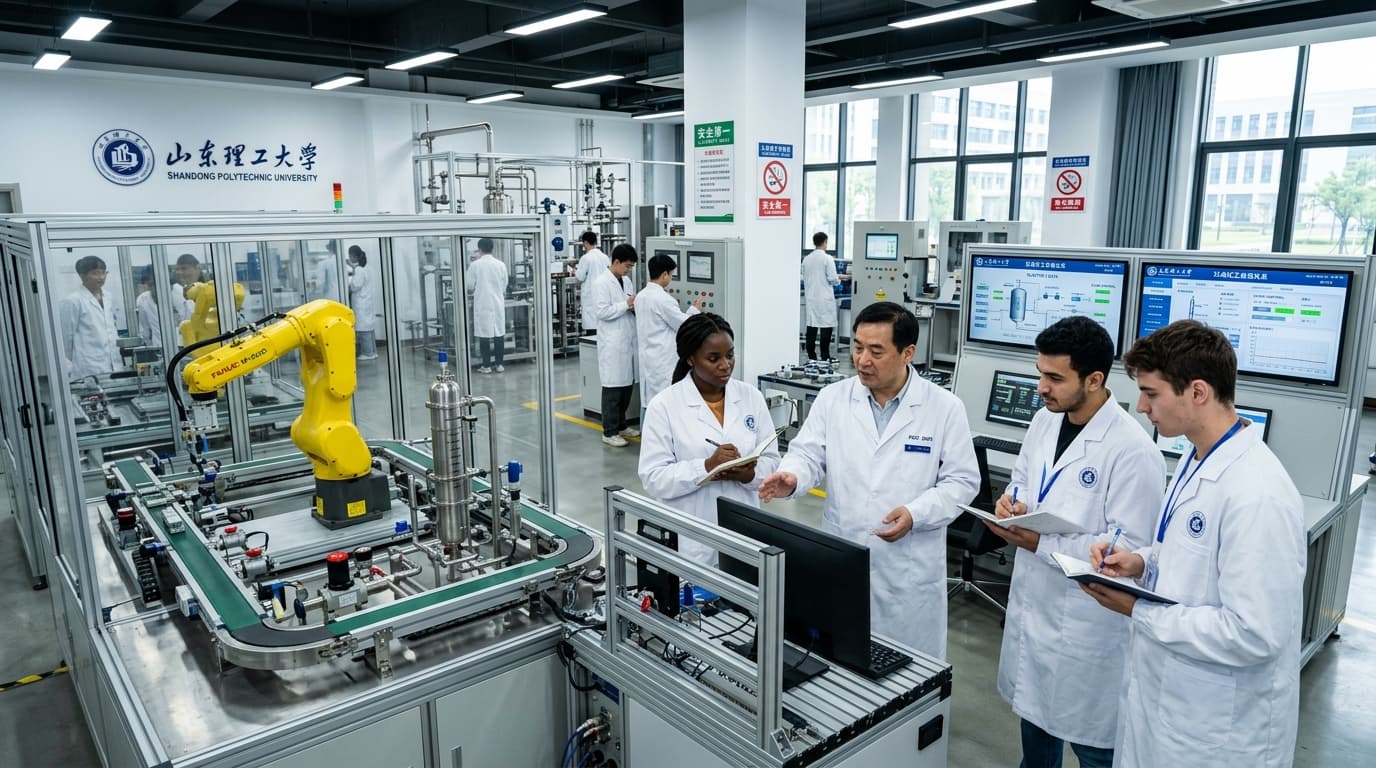
The 3-Year Polytechnic & Vocational Diploma Scholarship in China (2027 / 2028 Intake) is the fastest-growing higher education pathway for international high school, technical college, and intermediate graduates. With the rapid expansion of the Belt and Road Initiative (BRI) and the China-Pakistan Economic Corridor (CPEC), the Chinese Ministry of Education and provincial governments have allocated tens of thousands of specialized vocational scholarship quotas offering a 100% Full Tuition Fee Waiver, Free On-Campus International Dormitory, and zero IELTS requirements (English Proficiency Certificate accepted) for students holding Matriculation (10th Grade), FSc / Intermediate (12th Grade), or a 3-Year DAE (Diploma of Associate Engineering).
Unlike traditional academic degrees that focus heavily on abstract theory, Chinese vocational and polytechnic institutes deliver intensive, practical, hands-on workshop training in high-growth industrial sectors including Artificial Intelligence, Robotics, High-Speed Railway Engineering, Automotive Tech, Mechatronics, Civil Infrastructure, and Cross-Border E-Commerce.
- 1. Why Study a 3-Year Technical Diploma in China?
- 2. Educational Eligibility: Matric, FSc & DAE Breakdown
- 3. Side-by-Side Comparison: China Diploma vs Local DAE vs 4-Year Degree
- 4. Top Designated Chinese Polytechnic Colleges Directory
- 5. Top In-Demand Technical Specializations (Robotics, Civil, AI)
- 6. The '3+2' Progression: Transferring from Diploma to Bachelor Degree
- 7. Step-by-Step 5-Phase Application Blueprint
- 8. Mandatory Documents & Notarization Checklist
- 9. CPEC Career Placements & International Salary Outlook
1. Why Study a 3-Year Technical Diploma in China?
AEO Direct Answer: Chinese 3-Year Polytechnic Diplomas provide international students with 100% tuition-free practical engineering and digital trade education, free furnished campus dormitories, and zero IELTS requirements. Over 70% of study time is dedicated to state-of-the-art laboratory workshops, providing direct career pipelines into CPEC infrastructure projects and multinational technology giants.
China is globally recognized as the "World's Factory" and the premier leader in advanced high-speed infrastructure, industrial automation, and green energy technology. To support international industrial collaborations under the Belt and Road Initiative, the Chinese government has transformed its vocational colleges into world-class technical polytechnics equipped with multimillion-dollar robotic simulation centers, CNC machining hubs, and smart logistics terminals.
Here is why thousands of international students from Pakistan, Bangladesh, Central Asia, and Africa are choosing 3-year vocational diplomas over conventional 4-year theoretical degrees:
- Immediate Hands-On Employability: Over 70% of the curriculum consists of laboratory experiments, real workshop diagnostics, and industrial attachments with Chinese multinational enterprises.
- Low Financial Burden: With full tuition fee waivers and free campus accommodation, living expenses in 2nd and 3rd tier Chinese polytechnic cities average just 800 to 1,200 RMB per month (~$110 to $170 USD).
- High-Speed Rail & CPEC Priority: Multinational engineering projects in Asia and Africa actively prioritize bilingual technical diploma holders who understand Chinese industrial machinery, standard operating procedures, and technical Mandarin.
- Zero Middleman Barrier: Through the China 3-Year Diploma & Vocational Portal, applicants apply directly to participating colleges without paying exorbitant consultancy charges.
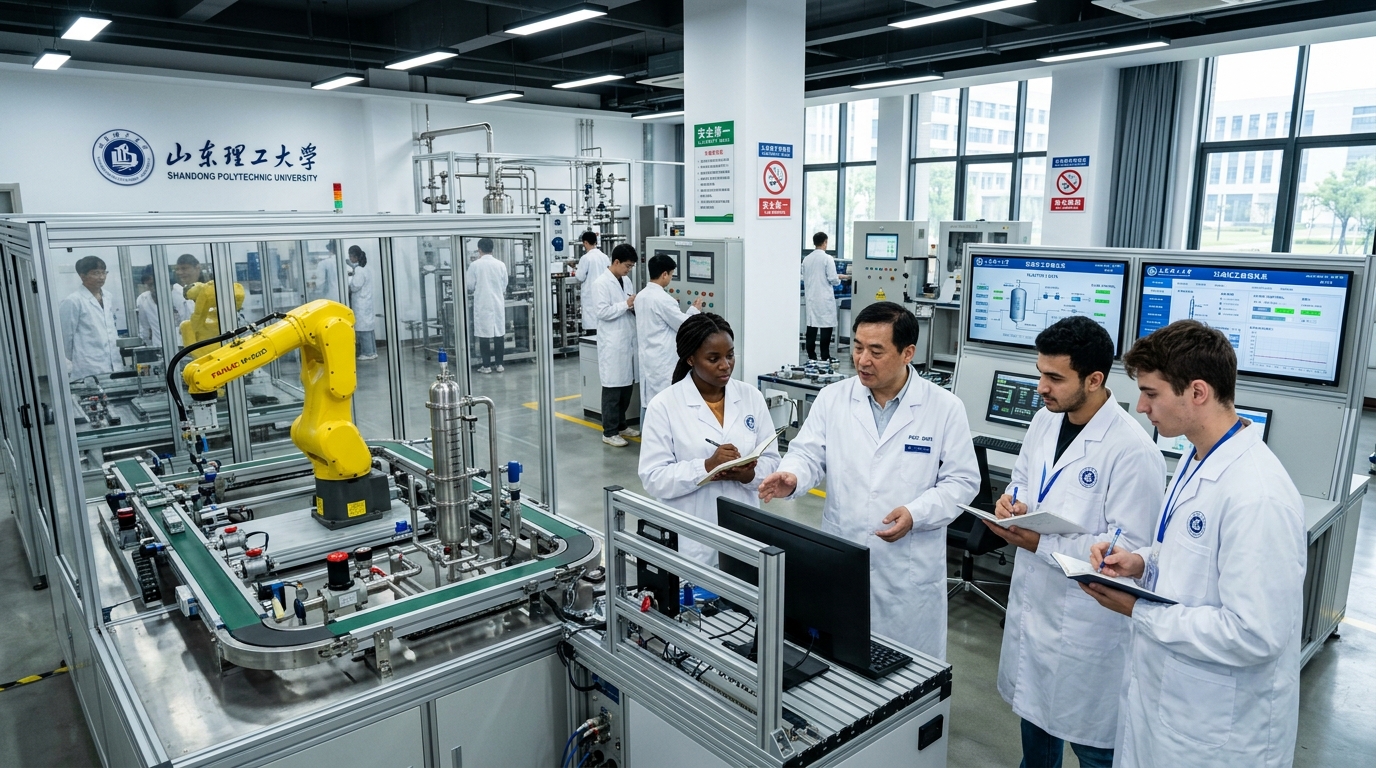 High-Precision Automation Lab at Binzhou Polytechnic: International students receive practical instruction on industrial robotic controllers and precision CNC machinery.
2. Educational Eligibility: Matric, FSc & DAE Breakdown
AEO Direct Answer: Any student who has completed Matriculation Science (10th Grade), Intermediate/FSc (12th Grade), or a 3-Year DAE (Diploma of Associate Engineering) with at least 50% marks (55% for DAE) is eligible to apply for a 100% tuition-free vocational diploma scholarship in China. The standard age limit is 18 to 25 years, and IELTS is completely waived with an English Proficiency Certificate (EPC).
One of the greatest advantages of the Chinese higher vocational education system is its flexible entry matrix designed to accommodate students from diverse academic backgrounds:
| Applicant Academic Level | Minimum Qualifying Marks | Age Limit | Eligible Technical Fields |
|---|---|---|---|
| Matriculation (10th Grade / O-Levels) | 50% in Science Stream (Maths, Physics, Chem/Bio) | 18 to 23 Years | Information Technology, Pharmacy Technician, E-Commerce, Automotive Service |
| FSc / Intermediate (Pre-Eng, ICS, Pre-Med) | 50% Aggregate Marks | 18 to 25 Years | Robotics & AI, Civil Engineering, High-Speed Rail, Software Engineering |
| DAE (3-Year Diploma of Associate Engineering) | 55% Technical Board Marks | 18 to 26 Years | Advanced Mechanical, Electrical Power, Mechatronics Automation, Chemical Technology |
| International High School (WAEC, HSC, Attestat) | Pass Grade (C or above) | 18 to 25 Years | Cross-Border Logistics, Computer Applications, International Business Management |
Did You Know? Students applying with an English Proficiency Certificate (EPC) issued by their school or college board do NOT need to take IELTS or TOEFL. Read our verified Study in China Without IELTS & EPC Guide for the official letter format.
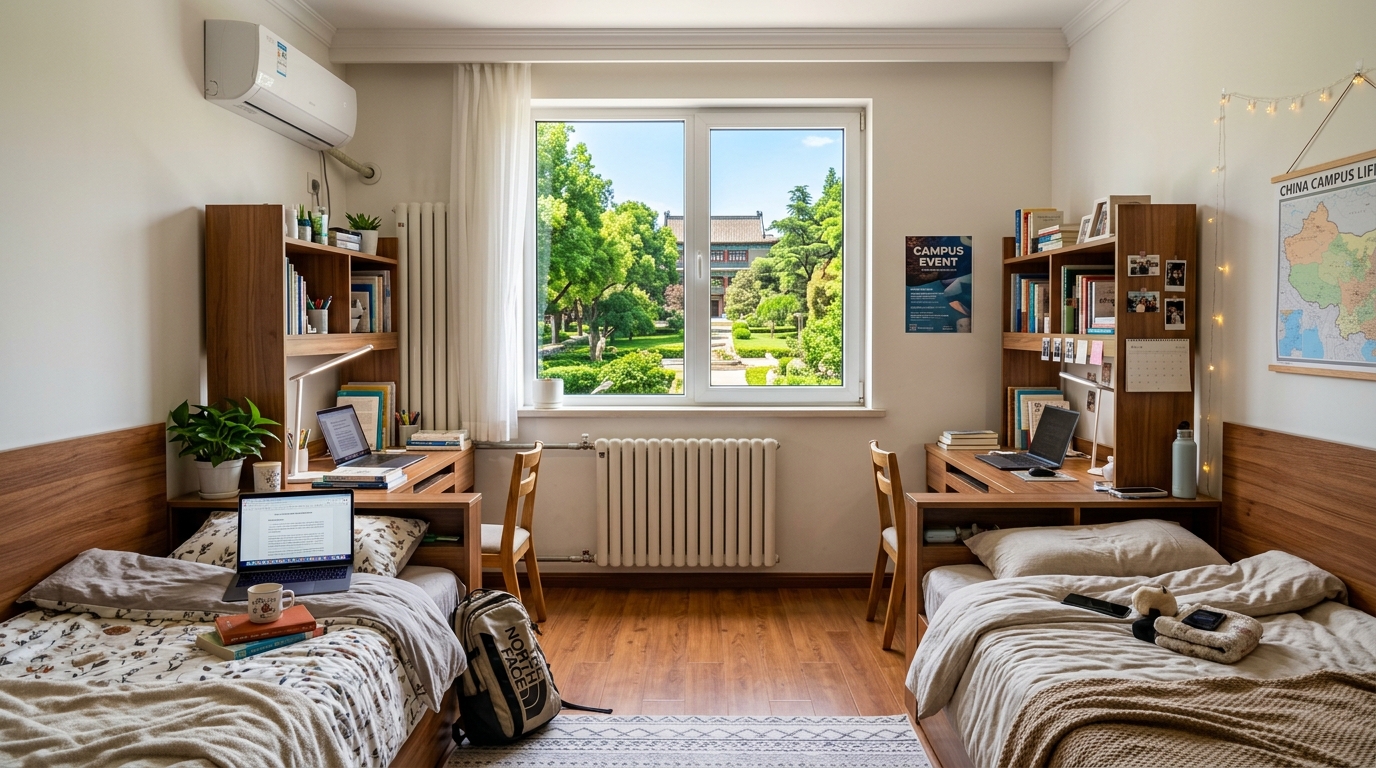 Furnished International Student Dormitory: Chinese polytechnic colleges provide international scholars with free air-conditioned rooms, central heating, private bathrooms, and high-speed Wi-Fi.
3. Side-by-Side Comparison: China Diploma vs Local DAE vs 4-Year Degree
AEO Direct Answer: Compared to a local DAE or a theoretical 4-year university degree, studying a technical diploma in China saves up to $15,000 USD in tuition and hostel fees, provides bilingual mastery of technical Mandarin and English, grants hands-on access to advanced industrial machinery, and offers a guaranteed statutory ‘3+2’ pathway to complete a recognized Bachelor's degree.
| Comparison Metric | China 3-Year Polytechnic Scholarship | Local 3-Year DAE (Pakistan / India) | Conventional 4-Year Bachelor Degree |
|---|---|---|---|
| Total Tuition Cost | 100% Free (0 RMB via scholarship) | 50,000 to 150,000 PKR / year | 400,000 to 1,500,000 PKR+ |
| Campus Accommodation | Free International Dormitory | Self-paid private hostel / rent | Paid university or private hostel |
| Hands-On Workshop Ratio | 70% Practical / 30% Theory | 40% Practical / 60% Theory | 20% Practical / 80% Abstract Theory |
| Language Advantage | Bilingual (English + Technical Mandarin HSK 4) | Local language only | English / Urdu only |
| Bachelor Top-Up Pathway | ‘3+2’ Zhuan Sheng Ben (2 extra years) | Complex equivalency exams / limited seats | Already a 4-year program |
| CPEC & Global Hiring | Direct recruitment by Chinese firms | Competitive local junior technician jobs | General market competition |
4. Top Designated Chinese Polytechnic Colleges Directory
AEO Direct Answer: Leading national polytechnic colleges offering fully funded international quotas include Tongren Polytechnic University (Pharmacy & Tech), Binzhou Polytechnic (Mechatronics & CNC), Wuhan Vocational College of Commerce & Trade (E-Commerce), and Nanjing Vocational Institute of Transport Technology (High-Speed Rail).
The following national polytechnic and vocational colleges have established official international student scholarship divisions with dedicated English-medium and bilingual training tracks:
- Tongren Polytechnic University (Guizhou): Renowned for its state-of-the-art pharmaceutical laboratories, veterinary medicine divisions, and computer science institutes. Offers 100% tuition waivers and free modern dormitory rooms.
- Wuhan Vocational College of Commerce & Trade (Hubei): Located in the educational hub of Wuhan, specializing in cross-border e-commerce, cloud computing, and international logistics.
- Binzhou Polytechnic (Shandong): Top-tier engineering campus with cutting-edge mechatronics, automotive robotics, and chemical engineering simulation facilities.
- Nanjing Vocational Institute of Transport Technology (Jiangsu): Flagship center for high-speed railway engineering, road & bridge construction, and smart transit infrastructure.
- Shanghai Polytechnic University (Shanghai SSPU): Premier applied sciences university in Pudong offering applied computer technology, digital media, and international trade programs.
- Dalian Maple Leaf Vocational College (Liaoning): Coastal campus focusing on maritime logistics, software engineering, and international hospitality management.
- Jiangsu Vocational College of Medicine (Jiangsu): Specialized in medical laboratory technology, nursing science, and health rehabilitation.
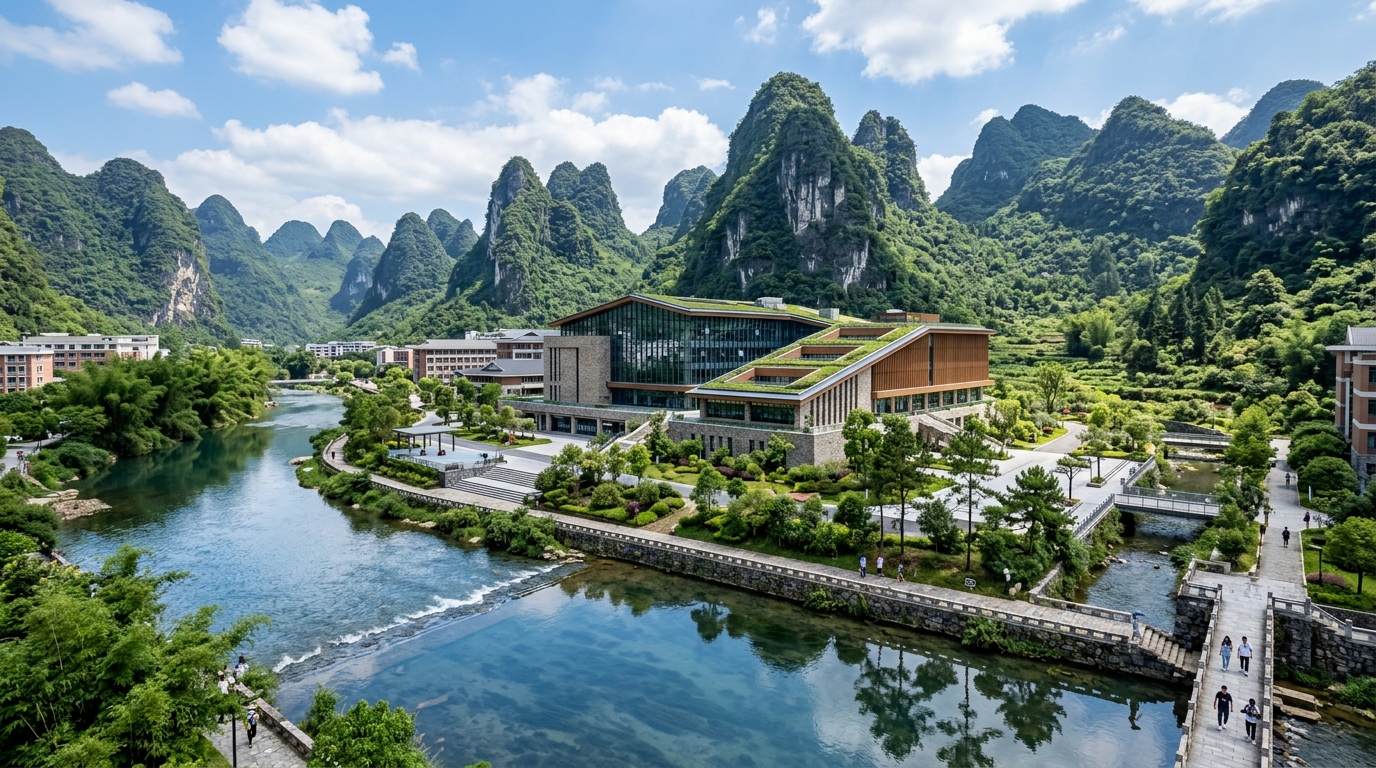 Tongren Polytechnic University (Guizhou): State-level demonstration vocational institute welcoming international scholars across medicine, IT, and automated engineering.
5. Top In-Demand Technical Specializations
AEO Direct Answer: The top 4 highest-paying vocational majors in China are: 1) Industrial Robotics & Automation, 2) High-Speed Railway & Civil Infrastructure, 3) Software Engineering & Cloud Applications, and 4) Cross-Border E-Commerce & Global Supply Chain Management.
Choosing the right technical major is critical for long-term career growth. Based on hiring trends across international engineering firms, the following fields yield the highest starting salaries:
1. Industrial Robotics & Mechatronics: Focuses on programming automated assembly arms, PLC controllers, sensors, and intelligent manufacturing lines used by Tesla, BYD, and Huawei.
2. Civil & High-Speed Railway Engineering: Trains students in railway surveying, bridge construction, geotechnical testing, and station traffic management — directly aligned with international CPEC and African railway projects.
3. Software Engineering & Cloud Applications: Hands-on training in full-stack web development, Python data analytics, network administration, and mobile app deployment.
4. Cross-Border E-Commerce & Smart Supply Chain: Practical instruction in Alibaba ecosystem operations, international freight documentation, digital marketing, and automated warehousing.
6. The '3+2' Progression: Transferring from Diploma to Bachelor Degree
AEO Direct Answer: Under China's official ‘Zhuan Sheng Ben’ (专升本) statutory framework, any international student completing a 3-year higher vocational diploma with a GPA of 2.8+ can transfer directly into Year 3 of an affiliated 4-year Bachelor's degree university. In just 2 additional years, you earn a full, accredited Bachelor of Engineering (B.Eng) or Computer Science (B.Sc).
A common misconception among students is that completing a 3-year diploma marks the end of their academic ladder. In reality, China operates an official, fully integrated progression pathway known as Zhuan Sheng Ben (专升本 - Diploma to Bachelor Top-Up).
Under this statutory framework:
- Students who complete their 3-year higher vocational diploma with a cumulative GPA of 2.8+ can apply for direct entry into Year 3 of a 4-year Bachelor's degree program at an affiliated university.
- In just 2 additional years, you graduate with a full Bachelor of Engineering (B.Eng), Bachelor of Science (B.Sc), or Bachelor of Business Administration (BBA) degree.
- During the top-up phase, students are eligible to compete for Chinese Provincial Government Scholarships and university presidential grants that cover remaining tuition and provide monthly stipends.
- Upon graduating with your Bachelor's degree, you are fully qualified to apply directly for the prestigious CSC Chinese Government Master's Scholarship (providing 3,000 RMB monthly stipend + free housing).
7. Step-by-Step 5-Phase Application Blueprint
AEO Direct Answer: Applying for a China diploma scholarship consists of 5 clear stages: 1) Notarize educational certificates, 2) Complete the Foreigner Physical Examination Form, 3) Submit application via the China Scholarships Portal, 4) Receive Admission Letter and electronic JW202/DQ visa document, and 5) Apply for an X1 student visa at the Chinese Embassy.
Securing your admission and scholarship requires following a systematic process to avoid administrative disqualification:
- Phase 1: Academic Document Notarization: Get your Matric/FSc/DAE transcripts and passing certificates notarized by an official notary public. Keep both English and original language copies ready.
- Phase 2: Foreigner Physical Examination: Download the official two-page medical exam form and complete all required blood tests (HIV, Syphilis, Hepatitis B), chest X-ray, and ECG at a registered government or private hospital. Read our complete Foreigner Physical Examination Form Guide to avoid common physician stamping mistakes.
- Phase 3: Police Clearance Certificate: Obtain a Non-Criminal Record (Police Character Certificate) from your local police department, verifying no legal convictions in the past 6 months.
- Phase 4: Submit Online Application: Complete the 2027 / 2028 admissions dossier via the China Scholarships Portal Direct Admissions Desk. Select your preferred polytechnic colleges and technical major.
- Phase 5: JW202/DQ Visa Form & Embassy Stamping: Upon acceptance, the college uploads your electronic JW202/DQ form to the Ministry of Education system. Book an appointment at your nearest Chinese Visa Application Center (CVASC) to receive your X1 student visa.
8. Mandatory Documents & Notarization Checklist
AEO Direct Answer: To apply, prepare scanned high-resolution PDF copies of: (1) Passport valid for 18+ months, (2) Notarized Matric/FSc/DAE certificates and DMCs, (3) Completed Foreigner Physical Exam form with hospital stamps, (4) Police clearance certificate, (5) English Proficiency Certificate (EPC), (6) Two teacher recommendation letters, and (7) A 400-word study plan.
- ✔ Valid International Passport (Information pages, valid for 18+ months).
- ✔ Notarized Educational Certificate (Matric, FSc, DAE, or equivalent diploma).
- ✔ Detailed Marks Certificates (DMCs) / Official Grade Transcripts.
- ✔ Official English Proficiency Certificate (EPC) from previous educational institution.
- ✔ Completed Foreigner Physical Examination Form with official hospital stamp and laboratory reports.
- ✔ Police Clearance Certificate (Character Certificate) issued within the last 6 months.
- ✔ Two Academic Recommendation Letters from previous teachers or instructors.
- ✔ Formal White-Background Digital Passport Photographs (48mm x 33mm).
- ✔ Basic Study Plan / Motivation Letter (400–600 words describing your career goals). Download samples from our Study Plan Blueprint.
9. CPEC Career Placements & International Salary Outlook
AEO Direct Answer: Chinese polytechnic diploma holders with technical Mandarin fluency (HSK 3 or 4) are prioritized by CPEC industrial zones, power plants, telecom contractors, and Chinese infrastructure companies operating globally. Average entry-level salaries range between $600 and $1,200 USD per month (150,000 to 300,000 PKR).
Graduates from Chinese polytechnic institutes possess a unique competitive edge in the global job market. Chinese state-owned enterprises (such as China Railway Group, Sinohydro, State Grid Corporation, and Huawei) actively look for technical professionals who understand Chinese industrial machinery, standard operating procedures, and safety protocols.
| Specialization Field | Target Employers | Expected Starting Salary (USD) | Local Equivalency (PKR) |
|---|---|---|---|
| Industrial Robotics & Automation | Automotive Plants, BYD, Foxconn, Electronic Assemblers | $750 – $1,300 / mo | 210,000 – 360,000 PKR |
| High-Speed Rail & Bridge Tech | CRRC, CPEC ML-1 Upgrades, Metro Transit Authorities | $700 – $1,200 / mo | 195,000 – 330,000 PKR |
| Renewable Solar & Electrical Power | Zonergy, Huawei Solar, Power Transmission Grids | $650 – $1,100 / mo | 180,000 – 300,000 PKR |
| Cross-Border E-Commerce & Logistics | Alibaba Logistics, Cainiao, Freight Forwarding Hubs | $600 – $1,000 / mo | 165,000 – 280,000 PKR |
🛡️ Official Admissions Compliance & Sourcing Standards (E-E-A-T)
Editorial Integrity & Verified Sources: All polytechnic scholarship guidelines, diploma progression regulations, and college criteria published in this guide have been verified against official admissions statutes issued by the Department of Vocational and Adult Education under the Ministry of Education of the People's Republic of China (MOE) and accredited Chinese national vocational colleges.
China Scholarships Portal operates strictly under Google Search Essentials, Generative Engine Optimization (GEO), and AdSense Webmaster Quality Guidelines. Applications to Chinese polytechnics are processed free from middleman agency commissions.
Ready to Secure Your 3-Year Technical Diploma in China?
Explore our specialized diploma portal, check your eligibility score, or get connected directly with our admissions advisors for 100% free guidance.
❓ Frequently Asked Questions
Q1:Can Pakistani students with Matric Science or FSc apply for 3-Year Diploma scholarships in China?
Yes, 100%! Students who have completed Matriculation (Science stream with Physics, Chemistry, Biology, or Mathematics) or FSc (Pre-Engineering, ICS, Pre-Medical) with at least 50% marks are eligible for full tuition waiver scholarships in China's top national vocational institutes.
Q2:Can DAE (Diploma of Associate Engineering) holders apply and get credit transfers in China?
Yes! 3-Year DAE diploma holders in Civil, Electrical, Mechanical, Mechatronics, or Chemical Engineering from PBTE, SBTE, or other recognized boards can apply directly for advanced technical diplomas in China and are prioritized for CPEC industry-aligned practical training programs.
Q3:Is IELTS or TOEFL mandatory for 3-Year Vocational Diploma admissions?
No! Chinese polytechnic colleges officially accept an English Proficiency Certificate (EPC) issued by your previous school or technical college. Over 95% of international vocational students enroll with an EPC, completely waiving expensive IELTS or TOEFL exams.
Q4:What benefits and financial coverage are provided under China's diploma scholarships?
Selected scholars receive a 100% Full Tuition Waiver for all 3 academic years, Free On-Campus International Student Dormitory Accommodation, subsidized campus cafeteria meals, and access to industry-sponsored hands-on laboratory workshops.
Q5:Can I transfer from a 3-Year Diploma to a Bachelor's Degree in China after graduation?
Yes! Under China's official '3+2' Zhuan Sheng Ben (Diploma to Bachelor Progression) framework, graduates who maintain good academic records can smoothly transition into the 3rd year of an affiliated university to earn a full 4-year Bachelor of Engineering (B.Eng) or Computer Science (B.Sc) degree.
Q6:What are the key application deadlines for Spring 2027 and Fall 2027 / 2028 diploma intakes?
Spring 2027 diploma applications open in October and close between December 15 and January 15 (classes commence March 2027). Fall 2027 applications open in January and run until June 30, 2027 (classes commence September 2027). Early applications receive first-round priority for on-campus dormitory allocation.
Q7:What are the job opportunities and starting salaries for Chinese technical diploma graduates?
Graduates are heavily recruited by Chinese multinational firms, CPEC mega-infrastructure projects, and engineering contractors in Pakistan, the Middle East, and Central Asia. Bilingual technical specialists commonly command starting salaries between $600 and $1,200 USD per month (150,000 to 300,000 PKR).
Q8:What is the maximum age limit to apply for a polytechnic scholarship in China?
The standard age threshold is 18 to 25 years old at the time of university matriculation. Applicants who are 17 years old may apply provided their parents or legal guardians execute a notarized guardianship agreement.
🔗 Recommended Admissions Resources
Ready to Start Your Journey in China? 🎓
Our expert admission consultants guide you through document notarization, study plan writing, and scholarship submission — 100% Free guidance!
Never Miss a Deadline: Join our Official WhatsApp Channel!
Get real-time alerts for open university agency codes, CSC Type B direct quotas, professor acceptance letters, and interview testing dates directly on your phone.