How to Write CSC Study Plan 2027 / 2028 | CSP Samples
Crafting an outstanding Study Plan for the CSC Scholarship (2027 / 2028 Intake) is the single most decisive factor that separates winning applicants from thousands of rejected submissions. Evaluated directly by university department deans, prospective research supervisors, and the China Scholarship Council selection committee, your study plan demonstrates your academic rigor, research clarity, and readiness to thrive in China's top universities. With 100% Full Tuition Waivers, free campus dormitory accommodation, and 3,000 to 3,500 RMB monthly stipends on the line under the CSC Scholarship, international scholars must submit a rigorous, plagiarism-free academic blueprint with no IELTS required (EPC accepted) and zero intermediary fee traps.
Why Your Study Plan Determines Your Scholarship Success
While your past academic GPA and university transcripts demonstrate historical achievement, your study plan tells Chinese university admissions committees what you will accomplish tomorrow. In top Chinese institutions such as members of the C9 League, professors receive hundreds of emails from international candidates every week. A superficial, generic essay copied from the internet is discarded within seconds. Conversely, a clearly articulated, well-researched study plan demonstrates intellectual maturity, academic commitment, and genuine enthusiasm for studying in China.
Study Plan vs. Research Proposal vs. Personal Statement (Comparison Matrix)
International candidates frequently confuse study plans with general statements of purpose or formal doctoral proposals. The following comparison matrix clarifies the specific expectations across degree levels:
| Document Type | Target Degree Level | Optimal Word Count | Core Objective & Focus | Crucial Evaluation Factors |
|---|---|---|---|---|
| Undergraduate Study Plan | Bachelor's Degree | 500 – 800 Words | Academic curiosity, foundational coursework, personal motivation, and enthusiasm for studying in China. | High school academic consistency, language learning aptitude, and clear career orientation. |
| Master's Degree Study Plan | Master's / Postgraduate | 800 – 1,200 Words | Comprehensive research problem, relevant literature review, methodology, and semester-by-semester roadmap. | Clear research question, analytical capability, and direct alignment with target university labs. |
| PhD Research Proposal | Doctoral / PhD | 1,500 – 3,000 Words | Original theoretical hypothesis, experimental design, preliminary literature citations, and anticipated publications. | Research originality, feasibility, experimental track record, and contribution to national grants. |
| Personal Statement (SOP) | All Degree Levels | 600 – 1,000 Words | Personal journey, extracurricular leadership, resilience, cross-cultural adaptability, and character. | Authenticity of voice, emotional maturity, ambassadorial potential, and cultural respect. |
| Professor Outreach Pitch | Pre-Application Stage | 300 – 500 Words | Concise email summarizing research overlap, CV highlights, and specific paper citations of the target supervisor. | Professional etiquette, brevity, demonstrated knowledge of the professor's published works. |
The Proven 6-Section Blueprint for an 800+ Word CSC Study Plan
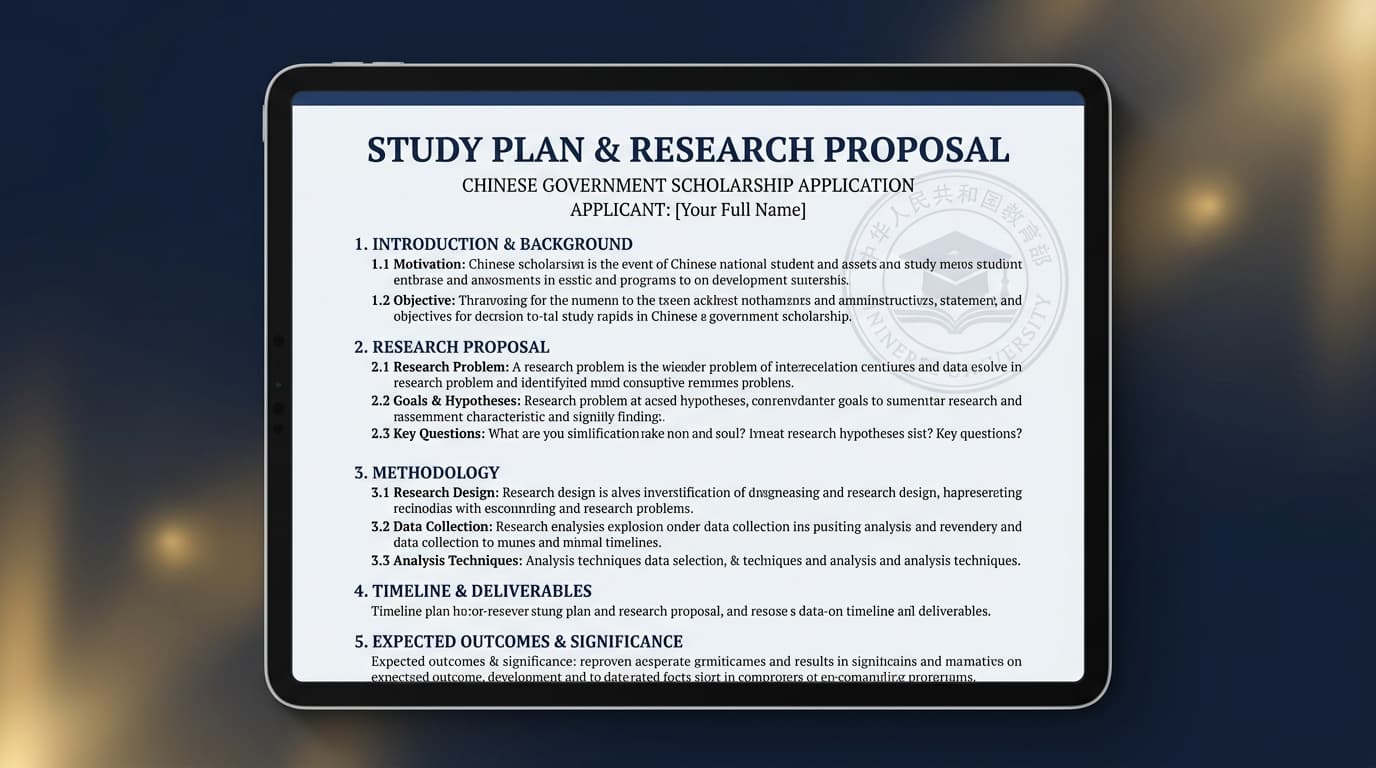
To ensure your document satisfies every evaluation criterion used by the China Scholarship Council, organize your study plan according to this standardized 6-section structure:
1. Title & Personal Academic Background (150–200 Words)
Open with a clear, professional title indicating your proposed major, target degree, and academic focus (e.g., "Study & Research Plan for Master's Degree in Artificial Intelligence & Robotics at Zhejiang University"). Concisely outline your undergraduate degree, cumulative GPA or honors, graduation institution, and key foundational coursework relevant to your target program.
2. Why Study in China & Target University Selection (150–200 Words)
Avoid cliché generalizations like "China is a beautiful country with ancient culture." Instead, articulate concrete academic reasons: mention China's global leadership in your discipline, state-of-the-art supercomputing clusters, advanced clean energy infrastructure, or specific research institutes at your target university. Reference specific professors or research labs located on our Chinese Universities Directory.
3. Specific Research Objectives & Problem Statement (250–350 Words)
This is the intellectual core of your document. Clearly define the specific research topic or technical challenge you plan to investigate. Explain why this problem is significant, summarize 2–3 recent scholarly papers or industry bottlenecks, and outline your proposed methodology (e.g., experimental modeling, statistical simulation, empirical surveys, or laboratory testing).
4. Semester-by-Semester Academic Schedule (150–200 Words)
Provide a structured chronological timeline dividing your degree into achievable milestones:
- Semester 1 (Fall): Complete required coursework, attend departmental seminars, achieve conversational Chinese language proficiency (HSK 2/3), and conduct comprehensive literature review.
- Semester 2 (Spring): Finalize experimental design, formulate research hypothesis, complete prerequisite lab safety training, and submit thesis proposal.
- Semester 3 (Fall): Execute core experiments, collect empirical data, perform computational analysis, and prepare preliminary manuscript for journal publication.
- Semester 4 (Spring): Complete thesis draft, publish findings in peer-reviewed journals, participate in international academic conferences, and successfully defend master's thesis.
5. Post-Graduation Career Vision & Bilateral Contribution (100–150 Words)
Describe how your degree will empower your future career in your home country or internationally. Emphasize how your training in China will contribute to bilateral economic, technological, or educational collaboration between China and your home nation under the Belt and Road framework.
6. Key Academic References (5–8 Citations)
Conclude with 5 to 8 formal academic citations in APA or IEEE format. Citing recent papers published by professors at your target Chinese university proves that you conducted authentic scholarly research before applying.
Real-World Study Plan Excerpt (Approved by CSC Committee)
Here is an illustrative excerpt showing the precise academic tone expected by Chinese admissions deans:
"During my undergraduate studies in Electrical Engineering, I focused on high-efficiency photovoltaic inverter architectures, achieving an overall thesis grade of 91/100. At Tsinghua University's Department of Electrical Engineering, I aim to extend this research under Professor [Supervisor Name]'s laboratory, specifically investigating grid-tied distributed micro-inverters for renewable energy storage systems. By leveraging Tsinghua's National Key Laboratory of Power Systems, I will develop predictive thermal management algorithms that bridge hardware efficiency with computational optimization."
How to Align Your Study Plan with a Professor's Ongoing Research
Securing a Professor's Acceptance Letter drastically elevates your CSC Type B scholarship selection odds. Before writing your proposal, visit the faculty profile pages of your target university via our Universities Portal. Read 2–3 recent papers published by your prospective supervisor in international journals (IEEE, Elsevier, Springer). Incorporate their research keywords directly into Section 3 of your study plan to show instant alignment with their funded research grants.
Free Downloadable Study Plan Templates (Word & PDF)
To assist international scholars in formatting their documents to perfection, China Scholarships Portal provides free downloadable study plan templates customized for STEM Engineering, Computer Science/AI, Medicine (MBBS/Clinical), Business/Economics, and Humanities. Access these resources directly on our Free Document Templates Desk.
⚠️ Common Pitfalls & Admissions Insider Advice
1. Submitting Generic Copy-Pasted Samples: Chinese universities run incoming study plans through Turnitin and specialized Chinese academic anti-plagiarism software. Copy-pasting templates from the internet results in immediate automatic disqualification.
2. Focusing Excessively on Personal Life Rather Than Academics: A study plan is not a creative storytelling diary. Dedicate at least 70% of your word count to your academic background, research problem, experimental methodology, and career vision.
3. Failing to Meet the 800-Word Threshold: The official CSC application guidelines strictly mandate a minimum of 800 words for Master's and PhD candidates. Submitting a brief 300-word statement signals lack of effort and leads to low committee scoring.
Frequently Asked Questions About CSC Study Plans
What is the required length for a CSC scholarship study plan?
The China Scholarship Council mandates a minimum of 800 words for Master's degree applicants and 1,000 to 1,500 words for PhD applicants. Undergraduate applicants should aim for 500 to 800 words focused on academic motivation and foundational learning goals.
Can I use AI tools like ChatGPT or DeepSeek to write my CSC study plan?
You may use AI tools to brainstorm research outlines or polish your English grammar, but you must write the core content, research questions, and literature citations yourself. Chinese university admissions committees use AI detectors and will reject applications showing synthetic or unverified claims.
What is the difference between a study plan and a research proposal?
A study plan covers your complete academic roadmap, including coursework, campus life, research timeline, and post-graduation goals. A research proposal focuses strictly on a technical problem, hypothesis, experimental design, and literature citations, primarily required for doctoral candidates.
Should my study plan be written in English or Chinese?
If applying for an English-taught degree program, your study plan must be written entirely in English. If applying for a Chinese-taught program with HSK certification, your study plan must be submitted in formal academic Chinese.
Where can I download approved CSC study plan templates?
You can download verified, editable Word (.docx) and PDF study plan templates directly from our official China Scholarships Portal Document Desk at chinascholerships.org/document-templates without any intermediary fees.
❓ Frequently Asked Questions
Q1:What is the required length for a CSC scholarship study plan?
The China Scholarship Council mandates a minimum of 800 words for Master's degree applicants and 1,000 to 1,500 words for PhD applicants. Undergraduate applicants should aim for 500 to 800 words focused on academic motivation and foundational learning goals.
Q2:Can I use AI tools like ChatGPT or DeepSeek to write my CSC study plan?
You may use AI tools to brainstorm research outlines or polish your English grammar, but you must write the core content, research questions, and literature citations yourself. Chinese university admissions committees use AI detectors and will reject applications showing synthetic or unverified claims.
Q3:What is the difference between a study plan and a research proposal?
A study plan covers your complete academic roadmap, including coursework, campus life, research timeline, and post-graduation goals. A research proposal focuses strictly on a technical problem, hypothesis, experimental design, and literature citations, primarily required for doctoral candidates.
Q4:Should my study plan be written in English or Chinese?
If applying for an English-taught degree program, your study plan must be written entirely in English. If applying for a Chinese-taught program with HSK certification, your study plan must be submitted in formal academic Chinese.
Q5:Where can I download approved CSC study plan templates?
You can download verified, editable Word (.docx) and PDF study plan templates directly from our official China Scholarships Portal Document Desk at chinascholerships.org/document-templates without any intermediary fees.
🔗 Recommended Guides for You
Ready to Start Your Journey in China? 🎓
Our expert admission consultants guide you through document notarization, study plan writing, and scholarship submission — 100% Free guidance!