Foreigner Physical Exam 2027 / 2028: Form & Tests | CSP
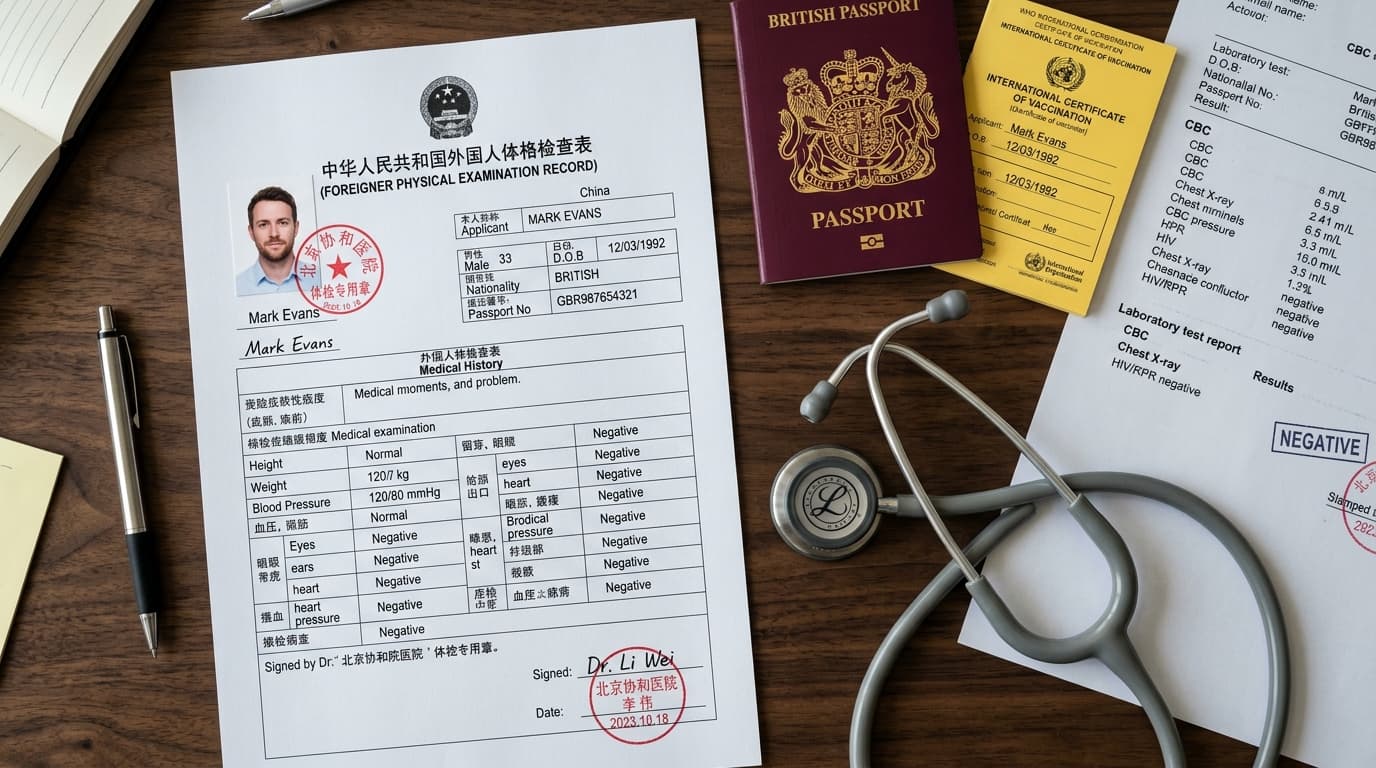
The Foreigner Physical Examination Form 2027 (外国人体格检查表) is China's official, legally mandated health verification document required for every international student applying for a Fully Funded CSC Scholarship 2027 / 2028, Silk Road Scholarship, or self-funded degree admission across Chinese universities. Administered under the joint supervision of China's Ministry of Education and the General Administration of Customs (Health Quarantine Bureau), this rigorous medical screening confirms that incoming foreign scholars are free from infectious, communicable, and severe chronic medical disorders that forbid entry under Chinese immigration law. Because an incomplete medical form or missing hospital stamp is the #1 administrative reason applications are rejected during initial document screening, China Scholarships Portal has compiled this definitive, step-by-step clinical and procedural blueprint.
Download the Official 2027 Foreigner Physical Examination Form (PDF)
Get the genuine, bilingual (English & Chinese) 2-page medical form approved by the China Scholarship Council and Chinese Embassies worldwide.
Why Do Chinese Universities & CSC Mandate the Physical Examination?
Under the Exit and Entry Administration Law of the People's Republic of China and international health quarantine treaties, the Chinese government safeguards public health by screening all foreign nationals intending to reside in China for more than 180 days (such as long-term degree students holding an X1 Student Visa). Top universities—including C9 League institutions such as Tsinghua University, Peking University, Zhejiang University, and Shanghai Jiao Tong University—enforce strict adherence to ensure incoming scholars can withstand the academic and climate demands of university life in China.
Specifically, the examination evaluates whether an applicant carries any condition that strictly forbids entry into China, such as:
- Active Communicable Diseases: Untreated pulmonary tuberculosis (TB), untreated syphilis, active cholera, plague, or infectious viral diseases.
- Severe Psychosocial & Mental Health Disorders: Severe psychoses, schizophrenia, or behavioral conditions that require institutional psychiatric care.
- Severe Cardiac & Organ Failure: Uncompensated heart failure, chronic end-stage kidney failure, or acute conditions preventing routine academic attendance.
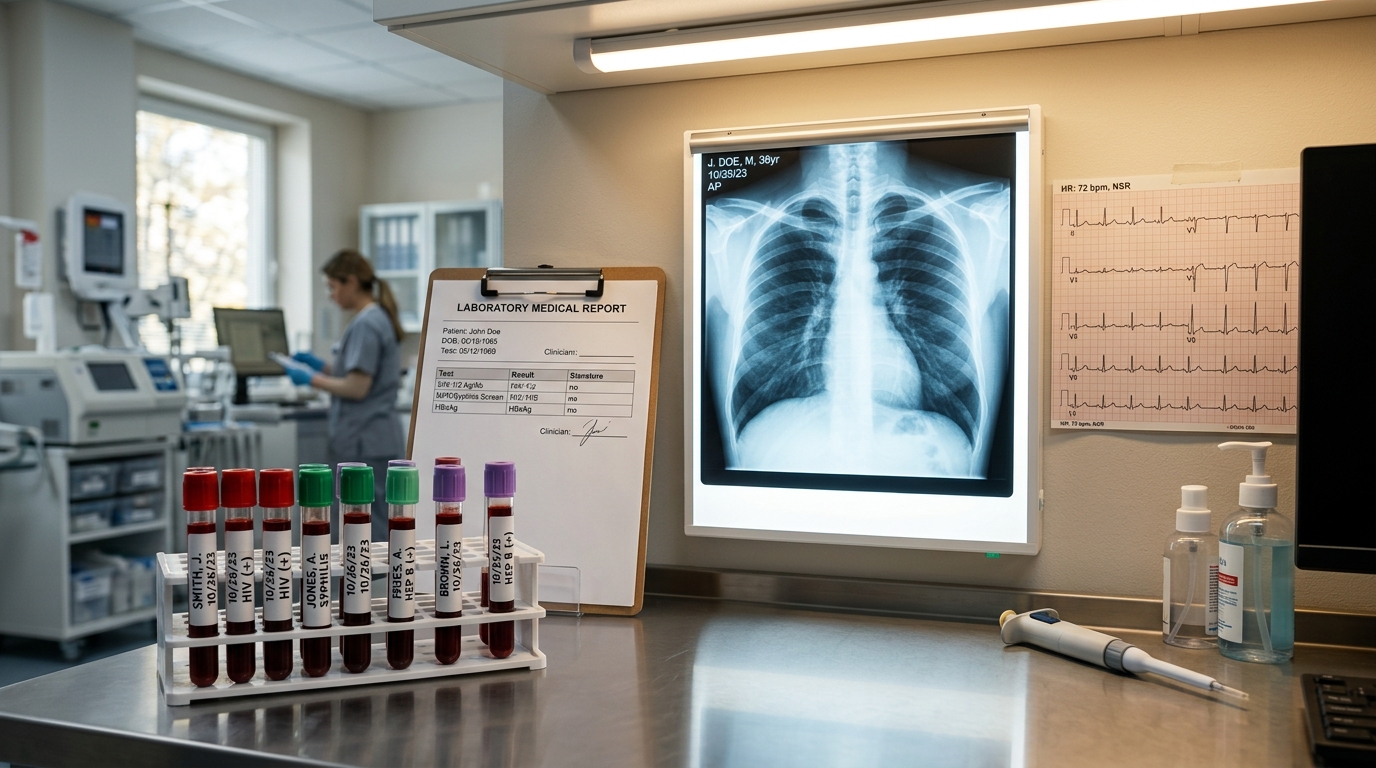 Clinical Laboratory Protocols: Blood test tubes for HIV, Syphilis, and Hepatitis B screening, alongside chest fluoroscopy (X-Ray) and ECG readout verification.
Page-by-Page Breakdown of the Foreigner Physical Examination Form
The standard official document is an exact 2-page bilingual form (Page 1 and Page 2). Both pages must be completed in English or Chinese by an authorized medical professional. Below is the precise clinical breakdown of each section:
Page 1: Personal Demographic Details & Physical Screening
- Demographic Information: Full legal name (must match your international passport character-for-character), Sex, Date of Birth, Birthplace, Nationality, Current Occupation, and Present Address.
- Passport Photograph & Cross-Stamp: You must paste a recent, color 2-inch passport-sized photograph (white background). Crucial: The examining hospital must stamp their official circular red or blue hospital seal overlapping the photo and the paper (half on the photo, half on the form). An unstamped photo is deemed fraudulent.
- Medical History Checkboxes: The doctor must record answers for historical infectious conditions including Typhus fever, Poliomyelitis, Diphtheria, Scarlet fever, Relapsing fever, Typhoid and Paratyphoid, and Epidemic cerebrospinal meningitis. In healthy candidates, all boxes should be checked "No" (None).
- General Physical Examination: Vital signs including Height (cm), Weight (kg), Blood Pressure (mmHg), Nutritional development, Vision (Right & Left, both uncorrected and corrected), Color vision (testing for color blindness), Hearing (ears), Nose, Tonsils, Heart rate/murmurs, Lungs, Abdomen, Spine, Extremities, and Nervous system. Each line item must be explicitly marked "Normal" or "Negative". Leaving any blank empty invalidates the document.
Page 2: Diagnostic Radiology, Cardiology & Blood Serology
Page 2 contains the specialized laboratory panels that require formal diagnostic equipment:
- 1. Chest X-Ray Examination (胸部X线检查): Evaluates your lungs and thoracic cavity to rule out active pulmonary tuberculosis (TB), lung lesions, or pleural effusion. The doctor must write a summary remark (e.g., "Lungs clear, normal heart and diaphragm, no active TB detected"), sign the section, and provide the attached X-Ray film report.
- 2. Electrocardiograph / ECG (心电图): Evaluates cardiac electrical activity and rhythm to rule out severe arrhythmias, myocardial ischemia, or conduction blockages. The doctor must write "Normal Sinus Rhythm, normal ECG" and provide the accompanying graphical ECG strip printout.
- 3. Laboratory Blood Serology Tests (化验室检查): This section requires blood draw analysis:
- HIV 1/2 Antibody Test (艾滋病病毒抗体): Must be explicitly recorded as Negative.
- Syphilis Serology (梅毒血清试验 - RPR, VDRL, or TPPA): Must be explicitly recorded as Negative.
- Hepatitis B Surface Antigen (乙型肝炎表面抗原 - HBsAg) & Liver Function: Routine screening for Hepatitis B and ALT/AST transaminase enzymes.
- 4. Final Medical Conclusion (检查结论): The physician must write an unambiguous overall fitness assessment, such as "Fit for higher education studies in China; no communicable or mental diseases found."
- 5. Official Physician Signature & Institutional Hospital Seal: The examining doctor must sign with their legal name, record their medical license registration number, write the date of examination, and affix the official circular hospital seal (医院公章) directly over the signature section.
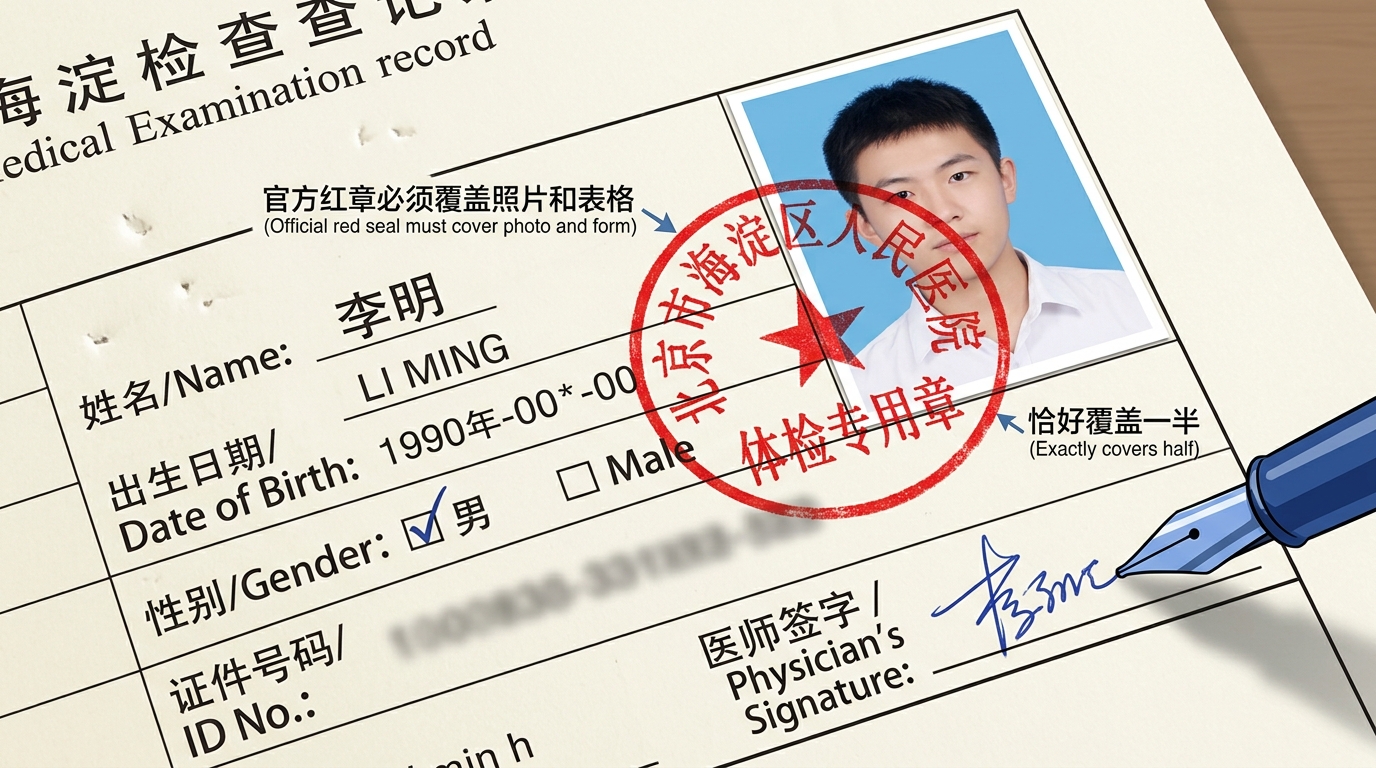 The Crucial 2-Stamp Protocol: Red institutional round hospital stamp overlapping the applicant's passport photo on Page 1, and official hospital seal next to the doctor's signature on Page 2.
The Crucial 2-Stamp Hospital Seal Protocol
Over 60% of international applicants make fatal errors regarding the placement and type of hospital stamps. Pay meticulous attention to these non-negotiable rules:
- Stamp #1 (The Photo Overlap Cross-Stamp on Page 1): When you paste your passport photograph in the upper right box of Page 1, the hospital administrative desk or doctor must press the circular hospital seal so that approximately 50% of the stamp impression covers your photograph and 50% covers the paper form. This prevents candidates from swapping photographs after medical clearance.
- Stamp #2 (The Institutional Seal on Page 2): At the conclusion of Page 2, the hospital must place their primary administrative circular seal directly over the hospital address and physician signature block.
- Acceptable Stamp Shapes & Ink: The seal must be a formal circular institutional hospital seal (round stamp) in red or dark blue indelible ink. Rectangular doctor name-slips, personal rubber stamps, or signature stamps without the hospital's institutional authority will lead to immediate disqualification by the Chinese embassy.
Mandatory Laboratory Attachments Checklist
Never submit the 2-page Foreigner Physical Examination form alone! Top Chinese universities require you to attach the official original diagnostic laboratory printouts issued by the hospital. Below is the complete mandatory attachment checklist:
| Diagnostic Test | Required Medical Standard | Mandatory Report Attachment | Chinese Medical Term |
|---|---|---|---|
| Chest X-Ray (Fluoroscopy) | Clear lungs, no active pulmonary lesions or tuberculosis (TB) | Original Radiologist Diagnostic Summary Report with hospital letterhead | 胸部X线检查报告 |
| Electrocardiogram (ECG) | Normal Sinus Rhythm, normal cardiac intervals (PR, QRS, QT) | Printed 12-lead ECG rhythm wave graph strip signed by cardiologist | 心电图图纸及分析 |
| HIV 1/2 Antibody Test | Non-Reactive / Negative | Pathology laboratory blood test printout with lab technician signature | 艾滋病毒抗体检测 (Negative) |
| Syphilis Serology (RPR/TPPA) | Non-Reactive / Negative | Quantitative or qualitative serological laboratory blood report | 梅毒血清学检查 (Negative) |
| Hepatitis B Surface Antigen | Non-Reactive / Inactive Carrier with normal liver enzymes | HBsAg blood test report sheet & ALT / AST liver function panel | 乙型肝炎表面抗原 (HBsAg) |
| Blood Routine (CBC) & Urine | Hemoglobin, WBC, Platelets, and Urinalysis within standard reference ranges | Complete Blood Count (CBC) and routine urinalysis test report sheets | 血常规与尿常规报告 |
Which Hospitals Are Accepted? (Hospital Selection Strategy)
You cannot walk into any neighborhood clinic or private pharmacy to complete this examination. To ensure your medical certificate is respected by the China Scholarship Council, Chinese provincial education bureaus, and consular visa officers, adhere to this selection hierarchy:
- Best Choice (Recommended): Public District / Government Teaching Hospitals: Any major state-run, government district headquarters hospital (DHQ), central civil hospital, or university medical college hospital. These institutions have integrated radiology, cardiology, and pathology laboratories, and possess official round seals registered with state authorities.
- Acceptable Choice: Accredited Private Polyclinics: Large, nationally accredited private hospital chains with comprehensive laboratory diagnostic wings and official round administrative seals.
- Strictly Prohibited & Rejected:
- Small private home-clinics or single-room doctor dispensaries.
- Diagnostic standalone labs that only do blood tests but have no doctor to complete the general physical exam.
- Forms stamped with a doctor's personal rectangular prescription stamp instead of the hospital's institutional seal.
The Strict 6-Month Validity Rule & Strategic Timing Window
The Foreigner Physical Examination Record has a strict statutory validity period of exactly 6 calendar months (180 days) from the date of the hospital stamp. This time constraint creates a critical dilemma for international applicants that requires precise strategic planning:
⏳ When Should You Take the Physical Exam for Fall 2027 Intake?
The Early Trap (Taking it too early): If you undergo the medical exam in August or September 2026, the 6-month validity will expire by February or March 2027. When your university forwards your file to the Ministry of Education for official visa authorization (JW202/DQ form) in May, or when you visit the Chinese Visa Application Center (CVASC) for your X1 visa in July, your medical certificate will be rejected as expired. You will be forced to spend time and money re-doing the entire medical exam.
The Late Trap (Taking it too late): Chinese Government Scholarship (CSC Type B) application deadlines close between February 15 and March 31. Waiting until late March risks missing application cutoffs if your lab blood results or chest X-ray reports take several days to process.
The Optimal Sweet Spot: Complete your physical examination between December 1, 2026, and February 10, 2027. This ensures that your certificate is valid during CSC scholarship evaluations (January to April), remains fully valid when your host university issues your admission package (June), and covers your Chinese Embassy X1 visa appointment (July / August).
Step-by-Step Hospital Walkthrough: What to Bring & What to Do
- Download & Print: Download the official bilingual Foreigner Physical Examination Form (PDF) from ChinaScholarships.org. Print 2 copies on clean A4 white paper (print Page 1 and Page 2 front-and-back or as 2 crisp single sheets).
- Preparation (Fasting): Fast for at least 8 to 12 hours before visiting the hospital (drink only water). Fasting is mandatory for accurate blood glucose and liver enzyme (ALT/AST) testing.
- What to Carry: Carry your original international passport, 2 recent passport-sized photos (white background), and your printed blank forms.
- Visit the Pathology Lab: Request the blood panel: HIV 1/2 antibody screen, Syphilis serology (VDRL/RPR), and Hepatitis B surface antigen (HBsAg).
- Visit Radiology & Cardiology: Undergo the posteroanterior (PA) chest X-Ray and a standard 12-lead resting Electrocardiogram (ECG).
- General Physical Checkup: Present the form and diagnostic reports to the examining physician. Ensure the doctor methodically fills out every line on Page 1 (vision, hearing, blood pressure, heart, lungs, extremities) and writes "Normal" or "Negative".
- Affix the Final Verdict & Signatures: Ensure the doctor writes a clear statement on Page 2 ("Fit for higher education in China; free from quarantine communicable diseases"), signs their full name, and dates the document.
- The Administrative Round Stamp: Take the completed form to the hospital administrative office or medical superintendent desk. Have them stamp the official circular seal overlapping your passport photo on Page 1, and stamp the bottom of Page 2 next to the doctor's signature.
- Collect Original Lab Sheets: Ensure you leave the hospital with the original printed lab reports for blood tests, ECG wave strip, and chest X-Ray radiologist summary.
How to Prepare and Upload the File to the CSC & University Portals
When applying on the official CSC Online Application System (Campuschina.org) or individual Chinese university admission portals (e.g., Zhejiang, Tsinghua, Harbin Institute of Technology), you must submit a single, pristine digital file:
- Scan at 300 DPI: Use a flatbed scanner or a high-quality document scanner app (such as Adobe Scan or CamScanner with no watermarks) in clear color mode. Never take angled, shadowy photos with your phone.
- Merge into a Single Multi-Page PDF: Combine your documents in the exact following chronological sequence:
- Page 1: Foreigner Physical Examination Form (Page 1 with stamped passport photo).
- Page 2: Foreigner Physical Examination Form (Page 2 with doctor signature and hospital round seal).
- Page 3: Official Chest X-Ray radiologist diagnostic report sheet.
- Page 4: Printed 12-lead ECG rhythm strip with physician remark.
- Page 5: Official laboratory blood test report sheet (HIV, Syphilis, Hepatitis B).
- Optimize File Size: The CSC portal enforces a strict 3MB per document file limit. Compress the merged PDF so that it stays between 1.5MB and 2.8MB while retaining high text sharpness and stamp legibility.
- Retain Originals Safely: Crucial: Keep the original hardcopy stamped form, laboratory blood printouts, ECG strips, and X-ray film sheets in a waterproof document folder. You must bring the physical originals with you to China for post-arrival customs clearance!
Post-Arrival Health Verification at China's Entry-Exit Quarantine Bureau
Many international students mistakenly believe that their medical obligations end once their Chinese student visa is issued. In reality, upon landing in China on an X1 student visa, Chinese law mandates that you convert your visa into an official Foreigner Residence Permit (居留许可) within exactly 30 calendar days.
During your first week on campus, your host university's International Student Office (ISO) will schedule your visit to the municipal Entry-Exit Inspection and Quarantine Bureau (出入境检验检疫局), also operating as the International Travel Healthcare Center (国际旅行卫生保健中心):
- Scenario A: Overseas Form Fully Endorsed (Best Case): If your overseas Foreigner Physical Examination form was properly stamped with overlapping round seals, contains all 3 original attached lab reports, and is within its 6-month validity window, the Chinese health quarantine officers will accept and endorse your form. They will issue your official Foreigner Health Certificate (健康证明) upon payment of a nominal administrative verification fee of approximately 60 to 100 RMB.
- Scenario B: Incomplete Overseas Form (Penalty Case): If your form lacks the stamp over the photo, omitted the attached blood lab report, or exceeded the 6-month cutoff, the quarantine authority will reject your overseas paperwork. You will be required to strip down and undergo the complete, exhaustive physical examination, blood draw, and chest X-ray on-site in China, costing approximately 400 to 600 RMB (~$60 to $85 USD) out of pocket.
⚠️ Top 6 Common Mistakes That Cause Physical Exam Rejection
1. Missing Stamp Over the Photo: A standalone photo without the hospital round seal overlapping it is considered unverified and leads to automatic rejection.
2. Omitting Attached Lab Test Sheets: Submitting only the 2-page form without the accompanying blood test report, ECG strip, and X-ray radiologist sheet triggers a document resubmission notice or application dismissal.
3. Expired 6-Month Validity: Taking the medical checkup too early (prior to November for Fall intake) leaves you with an expired document during summer visa processing.
4. Incomplete Checkboxes on Page 1: Leaving any field blank (such as spinal check, ears, or nutrition) instead of explicitly marking "Normal".
5. Using a Family Clinic or Dental Office: Applying via an unaccredited private doctor without formal radiology and clinical pathology testing capabilities.
6. Mismatched Passport Name: Spelling errors or missing middle names that do not match your international passport and CSC scholarship application.
Need Professional Review for Your Physical Exam & CSC Application?
Our senior admissions counselors at China Scholarships Portal review your medical forms, study plans, and documents with zero intermediary fee traps.
Frequently Asked Questions (FAQs) - Foreigner Physical Examination Form
Can I submit the Foreigner Physical Examination Form without the attached blood test and X-ray reports?
No, absolutely not. Chinese university admissions committees and the China Scholarship Council (CSC) will immediately reject your application if you only upload the 2-page form without the accompanying laboratory test sheets. You must attach the official hospital laboratory report for blood tests (HIV, Syphilis, Hepatitis B), the printed ECG graph strip, and the chest X-ray radiologist diagnostic report, all merged into a single PDF document.
What is the exact validity period of the Foreigner Physical Examination Record?
The Foreigner Physical Examination Record is strictly valid for only 6 calendar months (180 days) from the date the examining physician signs and stamps the form. Because university scholarship selections and embassy visa processing conclude between March and July, completing the medical examination too early (e.g., September or October) will cause it to expire before your official X1 student visa appointment. The recommended sweet spot for Fall 2027 intake is between December 1 and February 15.
Can a private clinic or local family doctor complete and stamp my Foreigner Physical Examination Form?
No. The form must be completed at a formal, accredited medical institution — preferably a public district headquarters hospital, tertiary teaching hospital, or certified national polyclinic. The examining facility must possess an official circular administrative institutional seal (round stamp). Small private neighborhood clinics, single-doctor dental offices, or general practitioner letterheads lacking formal pathology and radiology departments are universally rejected by Chinese consulates.
Does being a Hepatitis B carrier disqualify an international student from studying in China or winning a CSC Scholarship?
Under current revised Chinese health quarantine and immigration regulations, inactive Hepatitis B carriers are generally permitted to study in China and receive CSC scholarship funding for the vast majority of non-clinical academic programs (such as Engineering, Business, Computer Science, and Humanities). However, your liver enzymes (ALT and AST) must be within normal ranges. Clinical MBBS and culinary/food science programs may enforce stricter hospital internship restrictions.
What happens to my physical examination form after I land in China with an X1 visa?
Within 30 days of landing in China, you must take your original Foreigner Physical Examination Record and all attached hospital lab reports to the municipal International Travel Healthcare Center (Entry-Exit Inspection and Quarantine Bureau). The Chinese health quarantine officers will review your documents. If all stamps, X-ray films, and blood tests meet Chinese national standards, they will endorse your record and issue an official Foreigner Health Certificate (健康证明) for 60 to 100 RMB. If your overseas reports are incomplete, missing stamps, or expired, you will be forced to undergo a complete re-examination costing 400 to 600 RMB.
❓ Frequently Asked Questions
Q1:Can I submit the Foreigner Physical Examination Form without the attached blood test and X-ray reports?
No, absolutely not. Chinese university admissions committees and the China Scholarship Council (CSC) will immediately reject your application if you only upload the 2-page form without the accompanying laboratory test sheets. You must attach the official hospital laboratory report for blood tests (HIV, Syphilis, Hepatitis B), the printed ECG graph strip, and the chest X-ray radiologist diagnostic report, all merged into a single PDF document.
Q2:What is the exact validity period of the Foreigner Physical Examination Record?
The Foreigner Physical Examination Record is strictly valid for only 6 calendar months (180 days) from the date the examining physician signs and stamps the form. Because university scholarship selections and embassy visa processing conclude between March and July, completing the medical examination too early (e.g., September or October) will cause it to expire before your official X1 student visa appointment. The recommended sweet spot for Fall 2027 intake is between December 1 and February 15.
Q3:Can a private clinic or local family doctor complete and stamp my Foreigner Physical Examination Form?
No. The form must be completed at a formal, accredited medical institution — preferably a public district headquarters hospital, tertiary teaching hospital, or certified national polyclinic. The examining facility must possess an official circular administrative institutional seal (round stamp). Small private neighborhood clinics, single-doctor dental offices, or general practitioner letterheads lacking formal pathology and radiology departments are universally rejected by Chinese consulates.
Q4:Does being a Hepatitis B carrier disqualify an international student from studying in China or winning a CSC Scholarship?
Under current revised Chinese health quarantine and immigration regulations, inactive Hepatitis B carriers are generally permitted to study in China and receive CSC scholarship funding for the vast majority of non-clinical academic programs (such as Engineering, Business, Computer Science, and Humanities). However, your liver enzymes (ALT and AST) must be within normal ranges. Clinical MBBS and culinary/food science programs may enforce stricter hospital internship restrictions.
Q5:What happens to my physical examination form after I land in China with an X1 visa?
Within 30 days of landing in China, you must take your original Foreigner Physical Examination Record and all attached hospital lab reports to the municipal International Travel Healthcare Center (Entry-Exit Inspection and Quarantine Bureau). The Chinese health quarantine officers will review your documents. If all stamps, X-ray films, and blood tests meet Chinese national standards, they will endorse your record and issue an official Foreigner Health Certificate (健康证明) for 60 to 100 RMB. If your overseas reports are incomplete, missing stamps, or expired, you will be forced to undergo a complete re-examination costing 400 to 600 RMB.
🔗 Recommended Guides for You
Ready to Start Your Journey in China? 🎓
Our expert admission consultants guide you through document notarization, study plan writing, and scholarship submission — 100% Free guidance!