CSCA Exam Guide 2027 / 2028: Syllabus & Papers | CSP
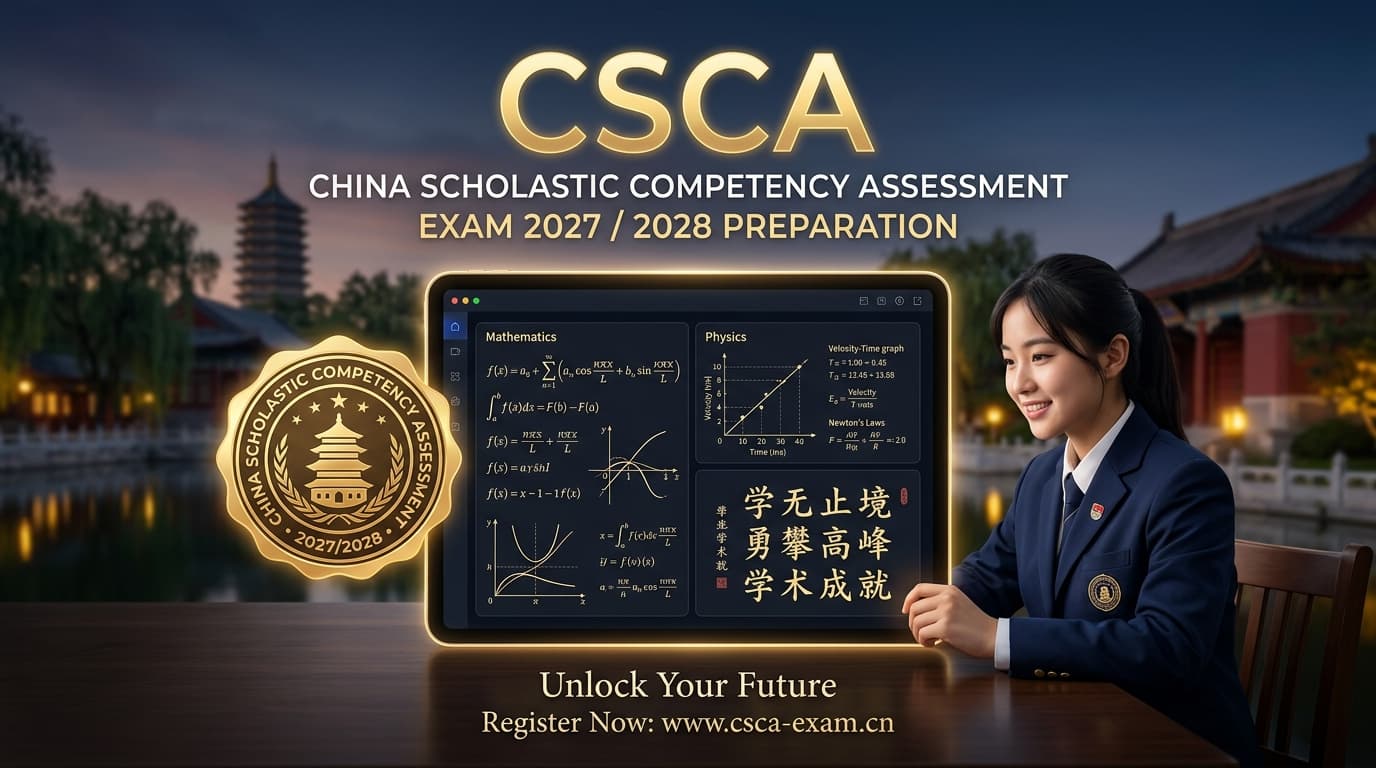
The CSCA Exam 2027 / 2028 (China Scholastic Competency Assessment) is the newly established, standardized academic entrance examination mandated by China's Ministry of Education and the China Scholarship Council (CSC) for all international students applying for undergraduate (Bachelor's) degree programs. Administered exclusively through the official testing portal (www.csca.cn), the CSCA acts as China's international equivalent to the SAT, ACT, and Gaokao, providing universities with a unified benchmark of scholastic readiness in Mathematics, Physics, Chemistry, and Professional Chinese. If you are seeking admission or a 100% Full Tuition Waiver, Free University Housing, and a 2,500 RMB monthly stipend under the Fully Funded CSC Scholarship 2027 / 2028, submitting a competitive CSCA score has officially become the defining factor for institutional selection.
Why Did China Introduce the CSCA Exam? (Background & Strategic Purpose)
Historically, international students applying for undergraduate studies across China submitted disparate national high school certifications — such as British A-Levels, American High School Diplomas, International Baccalaureate (IB), Pakistani HSSC / FSc, West African WASSCE, or Russian Attestat. Because grading rigor and curricular depth varied drastically across countries, Chinese university admission committees struggled to evaluate applicants on an equitable academic standard.
Under the directive of China's Ministry of Education, the China Scholastic Competency Assessment (CSCA) was launched to establish a transparent, objective meritocracy. Much like how American universities historically utilized SAT subject tests, top Chinese universities (including the elite C9 League: Tsinghua, Peking University, Zhejiang University, and SJTU) now utilize CSCA scores to determine:
- Direct University Admission: Confirming foundational competency in pre-calculus, algebra, Newtonian physics, and foundational chemistry.
- CSC Scholarship Type A & Type B Quota Allocation: Prioritizing candidates scoring in the 80th percentile or above for full tuition waivers and living allowances.
- Remedial Foundation Waivers: Allowing high-scoring scholars to skip mandatory 1-year preparatory pre-university college foundation courses.
Who Must Take the CSCA Exam? (Eligibility & Exemption Matrix)
Understanding whether your specific degree level or background mandates the CSCA exam is vital to avoid unnecessary examination fees or missing application deadlines.
| Applicant Category | CSCA Requirement Status | Tested Subjects | Exemption Conditions |
|---|---|---|---|
| Undergraduate (Bachelor's) Applicants | Mandatory | Mathematics + (Physics or Chemistry) + Chinese | None (Mandatory for all 2027/2028 applicants) |
| CSC Type B University Program (Bachelor's) | Mandatory | Science Track or Humanities Track | Strictly required by host university admission desks |
| CSC Type A Bilateral Program (Bachelor's) | Mandatory | Designated subject modules per bilateral embassy pact | Required unless bilateral government quota waives it |
| Master's & PhD Degree Applicants | 100% Exempt | None | Evaluated via Transcripts, Proposal, & Professor Acceptance |
| Non-Degree Language Students (1 Year / 1 Sem) | 100% Exempt | None | Evaluated via HSK level or Confucius Institute (CIS) quota |
Complete CSCA Exam Syllabus Breakdown by Subject
The CSCA examination evaluates rigorous high school graduation-level knowledge aligned with international standards. Each subject test is 60 to 90 minutes long and composed primarily of standardized multiple-choice questions, quantitative problem solving, and conceptual comprehension.
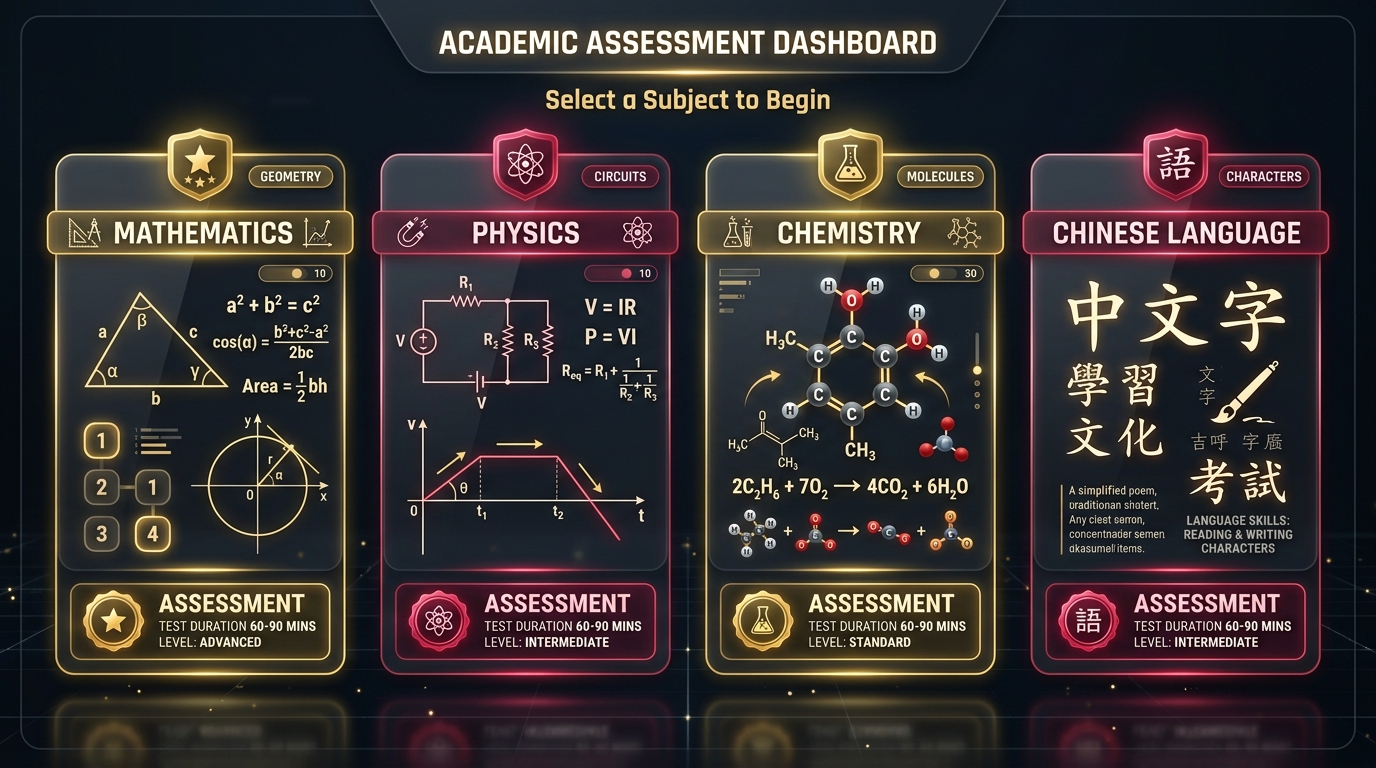 Official CSCA Exam Subject Tracks: Standardized 60-90 minute modules designed for international undergraduate admissions.
1. CSCA Mathematics Module (Compulsory for All Tracks)
The Mathematics examination is the cornerstone of the CSCA. It tests advanced quantitative fluency across 5 primary pillars:
- Functions & Algebra: Polynomials, logarithmic and exponential equations, inequalities, rational functions, and sequences and series (arithmetic and geometric progressions).
- Trigonometry: Trigonometric identities, inverse functions, sine and cosine laws, and periodic wave modeling.
- Analytic Geometry & Vectors: Coordinate geometry of straight lines, circles, ellipses, parabolas, and hyperbolas; 2D and 3D vector arithmetic and dot products.
- Differential & Integral Calculus: Limits, first and second derivatives, tangent lines, optimization problems, definite integrals, and area under curves.
- Probability & Statistics: Permutations and combinations, binomial distribution, mean, variance, and standard deviation.
2. CSCA Physics Module (Mandatory for STEM & Engineering Majors)
Required for candidates applying for Computer Science, Electrical Engineering, Mechanical Engineering, Civil Engineering, and MBBS medicine:
- Classical Mechanics: Kinematics in 1D and 2D, Newton's Laws of Motion, circular motion, gravitation, work, kinetic energy, conservation of linear momentum, and rotational equilibrium.
- Thermodynamics & Heat: Kinetic theory of gases, ideal gas equation (PV = nRT), first law of thermodynamics, heat engines, and specific heat capacity.
- Electromagnetism: Coulomb's law, electric fields and potentials, capacitors, Ohm's law, Kirchhoff's circuit rules, magnetic Lorentz force, and Faraday's law of electromagnetic induction.
- Waves & Optics: Simple harmonic motion, Doppler effect, Snell's law of refraction, total internal reflection, lens equations, and interference phenomena.
3. CSCA Chemistry Module (Mandatory for MBBS, Pharmacy & Chemical Majors)
Focused on fundamental molecular principles and laboratory chemical logic:
- Atomic Structure & Periodic Trends: Quantum numbers, electron configurations, electronegativity, ionization energy, and chemical bonding (ionic, covalent, metallic, hydrogen bonds).
- Chemical Reaction Kinetics & Equilibrium: Le Chatelier's principle, equilibrium constants (Kc, Kp), reaction rates, activation energy, and catalyst mechanisms.
- Acids, Bases & Electrochemistry: pH calculations, buffer solutions, titration curves, redox reactions, galvanic cells, and standard reduction potentials.
- Organic Chemistry Fundamentals: Nomenclature and functional groups of alkanes, alkenes, alcohols, aldehydes, ketones, carboxylic acids, and polymers.
4. CSCA Professional Chinese Module (Language Readiness)
Organized by the China Scholarship Council (CSC) and Beijing CSCDF, the CSCA tests professional academic language proficiency tailored to your undergraduate major, available across four distinct specialized branches:
- Humanities Chinese (文科中文): Evaluates academic reading comprehension, cultural history passages, sociology terminology, and logical argument synthesis for arts and humanities applicants.
- Business & Economics Chinese (经贸中文): Focuses on international trade vocabulary, financial charts, macroeconomic terms, and business report comprehension for finance, economics, and management majors.
- STEM & Engineering Chinese (理科中文): Tests mathematical and scientific terminology in Chinese characters (e.g., 方程 for equation, 速度 for velocity, 质量 for mass, 反应 for chemical reaction), enabling international science students to navigate lectures and lab manuals.
- Medical Chinese (医学中文): Designed for MBBS and clinical medicine candidates, covering fundamental human anatomical terminology, physiological concepts, and clinical diagnostic vocabulary in Chinese.
Three Official CSCA Exam Formats & Delivery Modes
According to the official csca.cn examination authority, international candidates can sit the assessment through three distinct formats depending on regional availability:
- 1. Home-based Online Exam (居家网考): The most widely chosen format by international applicants worldwide. You take the exam on your personal computer in a quiet private room, supervised live by online invigilators with real-time AI behavioral monitoring and dual cameras.
- 2. Concentrated Computer-based Exam (集中机考): Administered on secure computer terminals at designated authorized examination centers (primarily located across mainland China).
- 3. Paper-based Exam (纸笔考试): Conducted at select authorized international test center partner schools and overseas testing hubs using traditional paper booklets.
Step-by-Step Registration Guide on csca.cn (Official Portal)
All candidates must register directly on the official portal at https://csca.cn/home. Follow this verified walkthrough to secure your testing seat:
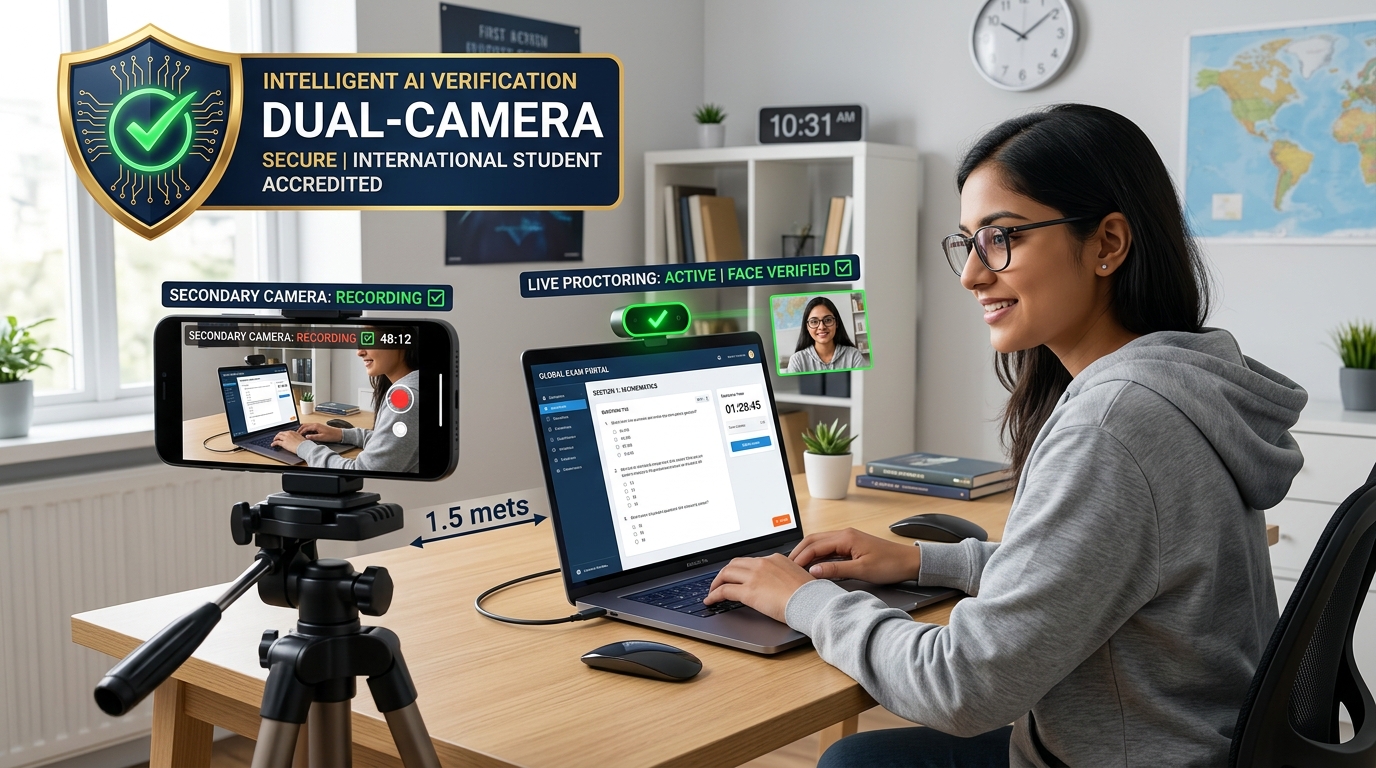 Official Dual-Camera Proctoring Setup: Candidate laptop front webcam + secondary smartphone recording desk and room at a 45-degree angle.
- Create Account: Visit
https://csca.cn/homeand register using a permanent personal email address (do not use temporary school emails). Note: Each email account can be bound to only one individual candidate. - Profile & ID Verification: Enter your legal full name exactly as it appears in your international passport. Upload a standard 2-inch ID digital photograph (JPG/JPEG format, 40KB – 200KB; white background; selfies and cropped passport bio-pages are strictly prohibited).
- Select Test Session & Subject Modules: Choose your examination batch (Winter Exam or Spring Exam) and your required subject combination (Single Subject or STEM/Humanities Bundle).
- Select Exam Format: Choose Home-based Online Exam or an authorized on-site test center.
- Payment & Admission Ticket (准考证): Pay the official examination fee online. Upon confirmation, download your official CSCA Examination Admission Ticket.
- System Compatibility Check: 48 hours before exam day, install the official CSCA test client software and complete the mandatory network speed test, camera check, and mic check.
⚠️ Critical Warnings: Top 5 Mistakes That Void CSCA Exam Results
1. Dual-Camera Setup Failure: During the online at-home examination, you must connect two cameras simultaneously: your laptop's front webcam (monitoring your face and eyes) and a secondary smartphone placed 1.5 meters behind your desk at a 45-degree angle (monitoring your hands, screen, and surrounding room). Failing to set up the secondary camera leads to automatic disqualification.
2. Room Entry Violations: No other person is permitted in the examination room. Any detected background voice, phone ring, or individual walking behind you triggers an instant AI flag and exam termination.
3. Unauthorized Browser Tabs: The CSCA proctoring browser locks down your operating system. Attempting to switch tabs, connect second monitors, or access virtual machines results in permanent score cancellation.
4. Mismatched Passport Name: If your name on your CSCA registration ticket does not 100% match the passport submitted on the CSC portal (studyinchina.csc.edu.cn), your score report will be rejected by university admissions.
5. Missing Application Deadlines: CSCA test results take 7 to 10 working days to process. You must register for a test date at least 3 weeks before your target university's scholarship application deadline.
CSCA Exam 2027 / 2028 Annual Schedule: 6 Testing Sessions & Official Fees
As officially announced on csca.cn, the CSCA Exam holds six testing sessions annually between November and June. This frequent schedule gives international applicants ample opportunity to sit the test early or retake it to maximize their scholarship chances.
| Annual Session | Exam Month | Registration Window (Beijing Time) | Target Scholarship Deadlines | Score Release |
|---|---|---|---|---|
| Session 1 (Winter Early Round) | November | Mid October – Late October | Early C9 League & CSC Type A Embassy Deadlines | 7-10 Days |
| Session 2 (Winter Main Round) | December | Mid November – Late November | CSC Type B University Program Round 1 | 7-10 Days |
| Session 3 (Prime CSC Intake) | January | Mid December – Early January | CSC Type B University Program Main Deadlines | 7-10 Days |
| Session 4 (Spring Main Round) | March | Mid February – Early March | Silk Road Scholarship & University CSC Round 2 | 7-10 Days |
| Session 5 (Late Spring Round) | April | Mid March – Early April | Provincial Government Scholarships (SGS, Jasmine, Zhejiang) | 7-10 Days |
| Session 6 (Summer Final Round) | June | Mid May – Early June | University Presidential, City & Self-Funded Intakes | 7-10 Days |
Official CSCA Examination Fee Breakdown & Payment Methods
According to official regulations published on csca.cn, examination fees are structured with clear standardized pricing:
- Single Subject Fee: Exactly ¥450 CNY (~$63 USD) if registering for only 1 standalone subject module (e.g., Mathematics only or Professional Chinese only).
- Subject Bundle Fee (2 or More Subjects): Exactly ¥700 CNY (~$98 USD) covering all selected subject modules (e.g., Math + Physics + Chemistry STEM bundle, or Math + Professional Chinese).
- Accepted Payment Gateways: Payments are processed in real time on csca.cn via Alipay (支付宝), WeChat Pay (微信支付), and Overseas Bank Cards / International Credit Cards (境外银行卡) including Visa, MasterCard, and UnionPay.
- Official Refund Policy: Order cancellation and refund requests can be submitted directly within your user portal on csca.cn prior to the registration close date, subject to official review.
Can You Retake the CSCA Exam to Improve Your Score?
Yes, 100%! If you are dissatisfied with your score in an earlier session, you are legally permitted to register for any subsequent session within the academic testing cycle. Chinese university admissions offices and the China Scholarship Council evaluate your highest valid composite score, ensuring that retaking the exam carries zero penalty. All CSCA results remain officially valid for two full years from the date of score publication.
Sample CSCA Test Questions & Problem Formats
To help you prepare effectively, review these representative sample questions reflecting the difficulty and style of the CSCA exam:
Sample Mathematics Question:
Question: Given the quadratic function f(x) = 2x² - 8x + k, for what value of k does the graph of f(x) have its minimum value equal to 3?
- (A) k = 5
- (B) k = 8
- (C) k = 11 (Correct Answer)
- (D) k = 14
Solution Walkthrough: The vertex of a parabola occurs at x = -b / (2a) = 8 / (2 * 2) = 2. Substituting x = 2 into the function yields: f(2) = 2(2)² - 8(2) + k = 8 - 16 + k = k - 8. Setting this minimum value equal to 3 gives k - 8 = 3, hence k = 11.
Sample Physics Question:
Question: A block of mass 4 kg slides down a frictionless incline of 30° from rest. What is the velocity of the block after it has traveled a distance of 10 meters along the incline? (Take g = 9.8 m/s²).
- (A) 7.0 m/s
- (B) 9.9 m/s (Correct Answer)
- (C) 14.0 m/s
- (D) 19.6 m/s
Solution Walkthrough: The acceleration down an incline without friction is a = g * sin(30°) = 9.8 * 0.5 = 4.9 m/s². Using the kinematic formula v² = u² + 2as with initial velocity u = 0: v² = 2 * 4.9 * 10 = 98, so v = √98 ≈ 9.9 m/s.
How to Link Your CSCA Score Report to Win CSC Scholarship 2027 / 2028
Once your official score report is issued on csca.cn, follow these strategic steps to maximize your scholarship selection probability:
- Download the official electronic score report containing the high-security cryptographic QR verification code.
- Log into the CSC Information Management System (Campuschina.org) under your CSC Type B application.
- Navigate to the "Supporting Documents" section and upload the score report under the "Standardized Entrance Exam / Academic Achievement Certification" slot.
- Log into your target university's individual international student portal (e.g., Tsinghua, Zhejiang, or USTC portal) and submit the certificate alongside your Foreigner Physical Examination Record and academic transcripts.
- Highlight your CSCA composite percentile in the introductory paragraph of your CSC Study Plan & Statement of Purpose to immediately stand out to the admissions review board.
🔗 Essential Admissions & Scholarship Resources for 2027 / 2028
- → CSC Chinese Government Scholarship Complete Guide
- → Free China Scholarship Eligibility Calculator
- → Download Foreigner Physical Medical Exam Form
- → 2027 / 2028 Top Chinese Universities Agency Code Directory
- → China Student Visa (X1 & X2) Complete Walkthrough
- → Direct Admissions Evaluation Desk (Zero Intermediary Fees)
Frequently Asked Questions About the CSCA Exam (FAQs)
Is the CSCA Exam mandatory for Master's or PhD applicants for the 2027 / 2028 intake?
No. The CSCA (China Scholastic Competency Assessment) is strictly mandatory for international applicants seeking undergraduate (Bachelor's degree) admissions and undergraduate Chinese Government Scholarships (CSC Type A and Type B). Master's and PhD candidates are completely exempt from taking the CSCA exam and are evaluated based on their bachelor's transcripts, research proposals, publications, and professor acceptance letters.
In which languages can international students take the CSCA Exam?
The CSCA offers two testing language tracks depending on your chosen degree major: an English-Medium track (for students applying to English-taught undergraduate programs in engineering, MBBS, computer science, or international business) and a Chinese-Medium track (for students applying to Chinese-taught programs requiring HSK proficiency). Test questions in mathematics, physics, and chemistry on the English track are provided in clear international English.
Where is the CSCA exam held: can I take it online at home?
Yes! Candidates can take the CSCA exam via an official At-Home Online AI-Proctored testing system administered through the official portal (www.csca.cn). Online test takers require a laptop or desktop computer with a functional webcam, microphone, stable high-speed internet, and a secondary smartphone placed behind them for 360-degree room monitoring. Physical paper-based test centers are also available in selected partner countries.
What is a passing score on the CSCA Exam to win a fully funded CSC Scholarship?
The CSCA uses a 100-point normalized scale per subject. While general university admission thresholds usually require a minimum score of 60 out of 100, competitive Chinese Government Scholarship (CSC Type B) nominations at prestigious C9 League institutions (like Tsinghua, Zhejiang, or SJTU) generally require a composite score of 78 to 85+ across Mathematics and science subjects.
How long is my CSCA score report valid and how do I submit it with my CSC application?
CSCA official score reports are valid for 2 academic years from the test date. Upon score release (usually within 7 to 10 working days on csca.cn), candidates receive a digital verified PDF score report with a unique QR authentication code that must be uploaded directly under the 'Academic Transcripts & Standardized Tests' section of the CSC portal (campuschina.org) and target university application desks.
❓ Frequently Asked Questions
Q1:Is the CSCA Exam mandatory for Master's or PhD applicants for the 2027 / 2028 intake?
No. The CSCA (China Scholastic Competency Assessment) is strictly mandatory for international applicants seeking undergraduate (Bachelor's degree) admissions and undergraduate Chinese Government Scholarships (CSC Type A and Type B). Master's and PhD candidates are completely exempt from taking the CSCA exam and are evaluated based on their bachelor's transcripts, research proposals, publications, and professor acceptance letters.
Q2:In which languages can international students take the CSCA Exam?
The CSCA offers two testing language tracks depending on your chosen degree major: an English-Medium track (for students applying to English-taught undergraduate programs in engineering, MBBS, computer science, or international business) and a Chinese-Medium track (for students applying to Chinese-taught programs requiring HSK proficiency). Test questions in mathematics, physics, and chemistry on the English track are provided in clear international English.
Q3:Where is the CSCA exam held: can I take it online at home?
Yes! Candidates can take the CSCA exam via an official At-Home Online AI-Proctored testing system administered through the official portal (www.csca.cn). Online test takers require a laptop or desktop computer with a functional webcam, microphone, stable high-speed internet, and a secondary smartphone placed behind them for 360-degree room monitoring. Physical paper-based test centers are also available in selected partner countries.
Q4:What is a passing score on the CSCA Exam to win a fully funded CSC Scholarship?
The CSCA uses a 100-point normalized scale per subject. While general university admission thresholds usually require a minimum score of 60 out of 100, competitive Chinese Government Scholarship (CSC Type B) nominations at prestigious C9 League institutions (like Tsinghua, Zhejiang, or SJTU) generally require a composite score of 78 to 85+ across Mathematics and science subjects.
Q5:How long is my CSCA score report valid and how do I submit it with my CSC application?
CSCA official score reports are valid for 2 academic years from the test date. Upon score release (usually within 7 to 10 working days on csca.cn), candidates receive a digital verified PDF score report with a unique QR authentication code that must be uploaded directly under the 'Academic Transcripts & Standardized Tests' section of the CSC portal (campuschina.org) and target university application desks.
🔗 Recommended Guides for You
Ready to Start Your Journey in China? 🎓
Our expert admission consultants guide you through document notarization, study plan writing, and scholarship submission — 100% Free guidance!